Nearly two hundred years ago, the Industrial Revolution began to reshape our perception of production, gradually forming the industrialized society of today. This revolution changed many aspects of our daily lives: it solved the problem of food shortages, made clothing more easily accessible, created jobs and altered our perceptions of labor. But it also had a price to pay for it, including pollution, alienation and distance from nature. Today, we are gradually coming to terms with the limitations of the existing model of development and the need to reevaluate the process of producing and consuming.
However, in recent years, there have been examples of different approaches towards growing food that show that a different development model is possible without losing any of the advantages achieved through industrialization. With the help of technology, research and infrastructure created during the previous two hundred years, one can reconnect with nature and discover what it can offer us. But the problem is probably how to use those resources differently.
Table of Contents
Rethinking the supermarket
The term ‘growth’ may be considered as the key component of the sustainable development model promoted by REWE Green Farming. Its concept cannot be called the concept of a supermarket, but rather of the whole complex which aims at the combination of different stages of food production, including retail and farming, seasonal crops and modern technologies of cultivation.
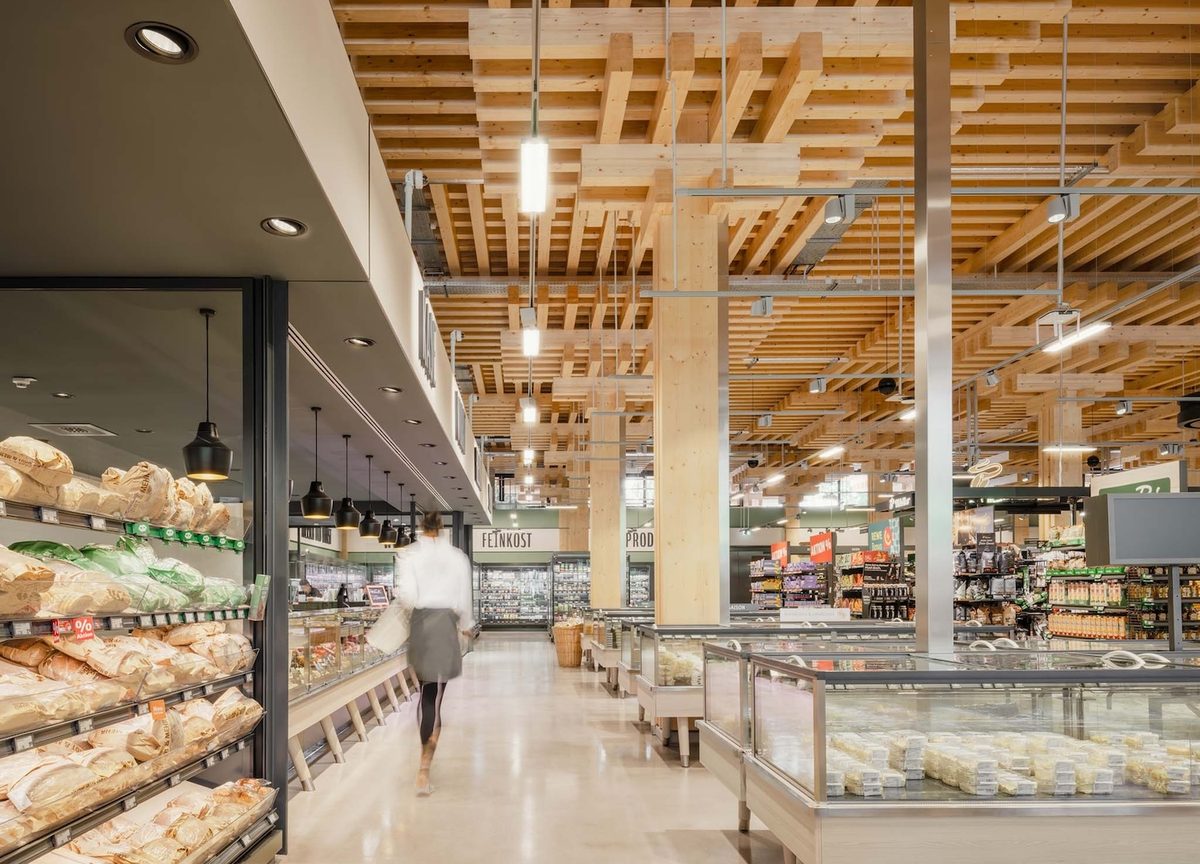
Being thought of as a contemporary timber market hall, the REWE Green Farming project involves a sustainable architectural model that is replicable in many locations and at the same time connected with its environment.
As it seems, the goal of the project is rather simple yet ambitious. The aim of the architectural concept is to reconnect the citizens with the process of food production. It is rather difficult now, as people are used to the existence of supermarkets with packed food, products that are available all-year-round, regardless their origin, because the convenience has become the norm. REWE Green Farming is aimed at returning the origin of the foodstuffs back to the citizens’ attention making cultivation the inseparable part of the shopping process.
Where architecture meets cultivation
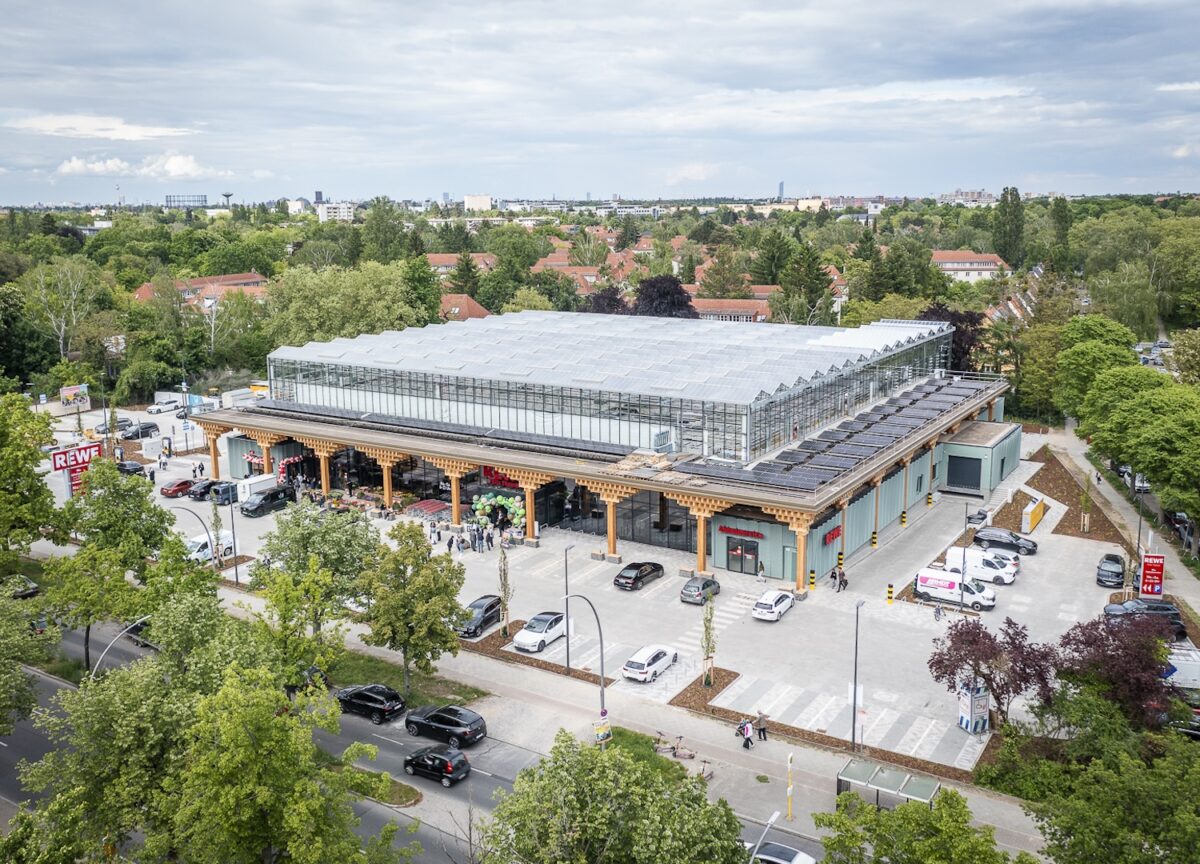
The Berlin project realized by ACME is the second implementation of REWE Green Farming idea after the prototype in Wiesbaden. Completed in 2026, it is a building incorporating 4000 square meters supermarket, 2800 square meters hydroponic rooftop farm and an additional little less then 500 square meters farming area on the ground floor. Thus, the REWE Green Farming turns the production and sale of food into one process taking place in the building.
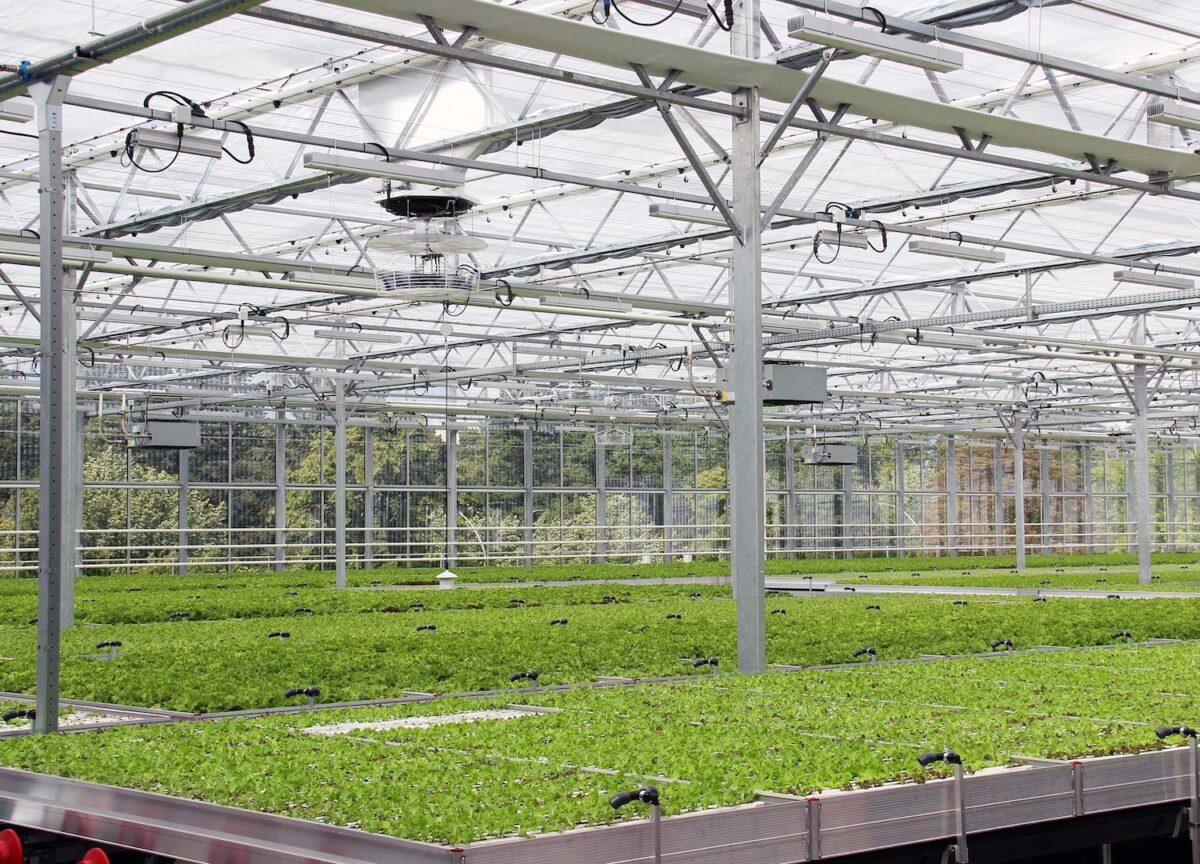
At the heart of the project is an integrated aquaponic system and modular greenhouse. Plants are grown in an automated hydroponic system, almost soil-free, receiving nutrients in the form of a special solution and being irrigated by the rainwater gathered in the rooftop cistern. Growing cycle of the plants lasts about 23 days and after it they are delivered to the processing room. Lettuce is processed and packed on the spot in order to sell it in the supermarket or distribute it elsewhere. Rooftop farm is capable to produce up to 900,000 salad mixes per year. It is a production chain that becomes open, accessible and, what is most important, part of the architectural design.
Transparency is not just an attribute, but also a space organization principle. Large glazing facades enable linking the interior space to the surrounding landscape, letting in daylight and providing an insight into activities that take place inside. A timber structure with characteristic arches gives a human scale to the shopping environment, making the supermarket a contemporary market hall. Thus, the productive infrastructure is not hidden from sight, but rather becomes an intrinsic part of the building’s identity.
This architectural principle is embodied in a modular timber structure composed of 72 columns with stacked timber capitals that sustain a vaulted structure of the interior. All components are manufactured in standard sizes and are designed for disassembly and reuse, which means that they do not need to be recycled before their reuse. Sustainability in this case is considered not only in relation to activities that take place inside the building, but also in relation to the process of assembly and potential reuse and reconfiguration of the structure.
Making production visible again
From the perspective of ACME studio, which is responsible for this practice, the approach of the architectural project reflects the interest in the interrelation between architecture, place, material and technology. ACME was established in 2007 and operates at different scales and disciplines, studying the program, location and other characteristics of every project in order to develop a building capable of adapting to environmental and social needs and reusing in the future. The REWE Green Farming becomes the practical embodiment of such an approach, in which architectural design and technological innovations help to reconsider a conventional building typology.
Perhaps the most striking feature of this project is the intention to change the meaning of an ordinary place. A supermarket is typically a place that provides customers with the opportunity to purchase some products; however, a person does not think about the process of their production. In the presented project, the gap between production and consumption is being erased and the process of buying products turns into an experience related to the comprehension of the ways of their production. The structure is not calling for a return to a pre-industrial state of living nor denying the convenience of modern society. Rather, it wonders whether the means of industrial development may enable us to create another bond with nature, where growth is no longer defined by the amount of products created but rather by the inclusion of the process of production into an overall cycle.

Ludovica Proietti
Ludovica Proietti, journalist, design historian and curator, teaches in universities and curates events, always exploring projects with fresh, unconventional perspectives.