Are we outsourcing our thinking to AI?
From generative exploration to service ecosystems, AI is transforming not only how we design, but how we think.

As spring arrives and the winter semester comes to a close, the University of Michigan campus turns greener—more vibrant, more alive. Yet while the seasons shift gradually, the pace of artificial intelligence (AI) continues to accelerate, reshaping our lives and disciplines at a much faster rhythm. AI is no longer emerging; it has become embedded, almost a default condition, across fields.
As a designer and educator, this transformation is increasingly shaping both my teaching and research. Each day, I find myself both amazed and in shock as I read design magazines and technology-relevant blogposts, witnessing and experiencing how rapidly AI is redefining creative and professional practices.
Gallery
Open full width




Open full width
This shift raises not only practical questions about tools and workflows, but also deeper reflections on how we think, design, and make sense of complexity in the age of AI.
In this article, I reflect on three key takeaways drawn from my recent teaching and research.
Key takeaway:
This article argues that Artificial Intelligence is not just changing how we design, but how we think, make sense, and assign value within design processes (Figure 1).
AI expands the discover phase into a generative exploration space
In my class, students now arrive with dozens of AI-generated concepts within minutes, but struggle to articulate why one idea matters more than another. Today, AI-enabled tools allow designers, and increasingly the general public, to rapidly explore a vast landscape of possibilities through prompt-based interactions.
With the rapid advancement of generative AI design tools, the early stage “Discover” phase of the Double Diamond Model has significantly expanded in both scale and accessibility. Traditionally, this phase relied on time-intensive research, ethnography, and ideation workshops.
Generative AI has fundamentally lowered the barrier to entry for ideation. Users can now generate hundreds of visual, conceptual, and narrative variations within minutes, transforming the divergent thinking process into a highly accelerated and iterative activity. For instance, tools like KREA enable users to produce AI-generated images, videos, and style transformations, while also offering enhancement and customization features that support rapid refinement.
Similarly, Figma Make integrates Artificial Intelligence directly into the design workflow, allowing designers to quickly prototype, iterate, and translate abstract ideas into tangible outputs.
Major industry platforms such as Adobe Creative Cloud have also embedded generative AI capabilities, enabling users to manipulate visuals through natural language prompts, adjusting compositions, modifying backgrounds, or generating entirely new assets. These tools not only increase efficiency but also reshape how designers engage with materials, shifting from manual creation to curatorial and decision-making roles.
More recently, platforms like OpenStudio further extend this paradigm by emphasizing human–AI co-creation. Rather than treating Artificial Intelligence as a tool for output generation alone, these systems position AI as a collaborative partner in the design process, enabling more seamless, intuitive, and dialogic interactions between human intent and machine intelligence.
As a result, the first phase of the Double Diamond is no longer simply about “discovering” problems; it has evolved into an expansive, generative exploration space where problem framing, idea generation, and early prototyping increasingly overlap. This shift raises critical questions about authorship, design expertise, and the role of human judgment in navigating an abundance of possibilities.
AI transforms service design into orchestrating ecosystems of agents
If Artificial Intelligence (AI) expands how we explore ideas, it also transforms how these ideas are organized into systems. As AI becomes increasingly embedded within service ecosystems, the role of service designers is undergoing a fundamental transformation.
Sarah Gibbons, Senior Vice President at the Nielsen Norman Group, highlights that in the era of AI, service designers must place greater emphasis on systemic sense-making, ensuring that increasingly complex, AI-mediated service journeys remain coherent, consistent, and meaningful for users.
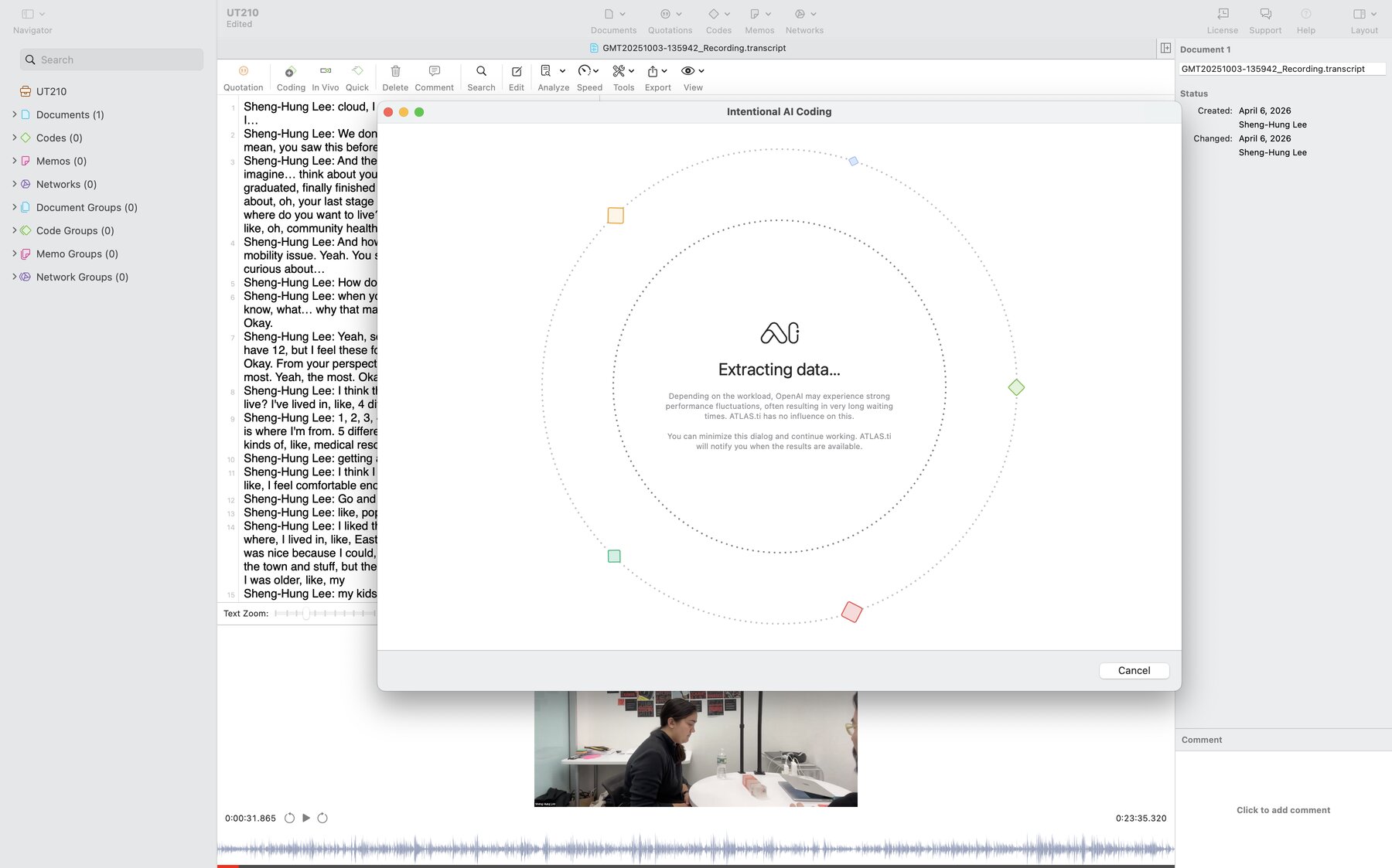
By systemic sense-making, I refer to the capacity to internalize, interpret, and connect information across contexts in order to form grounded judgment, not merely to generate outputs. For instance, when recording and analyzing interviews, AI can efficiently support tasks such as transcription, coding, and keyword identification (Figure 3). However, the implicit meanings, including the subtle cues, contradictions, and contextual nuances, emerge through human sense-making.
This shift becomes especially visible with the rise of multiple, interacting AI service agents and the emergence of tailor-made AI services. Consider the experience of a frequent traveler like myself. Traditionally, I might rely on platforms such as Google to compare flights. However, emerging AI agents are moving far beyond isolated optimization tasks.
Rather than simply returning options, these systems construct personalized, context-aware service ecosystems. Based on a user’s specific needs (e.g., a family trip) and situational context (e.g., an anniversary celebration), service AI agents can coordinate across domains, identifying not only cost-effective flights, but also curating hotels, arranging ground transportation, suggesting dining experiences, and recommending cultural activities such as museums.
Artificial Intelligence is no longer just a tool for search or efficiency; it becomes a tailor-made service orchestrator, dynamically assembling an integrated, end-to-end journey that aligns with the user’s preferences, intentions, and life context.
In this context, the role of the service designer expands beyond shaping the “look and feel” of individual touchpoints (e.g., user interfaces or interactions). A central emerging challenge is orchestrating and integrating multiple service AI agents across a service ecosystem. Designers must ensure that these distributed intelligences work together in a way that aligns with user goals, values, and long-term well-being.
Recent work such as Design Thinking with Artificial Intelligence by Daniel Graff, Mark Clark, Dan Li, and Lei Xia introduces the concept of exploratory AI, positioning AI as a medium that enables “communication” between user-side AI agents and provider-side AI agents. This reframes service design as a form of mediation and curation, where service designers must determine how different service AI agents interact, negotiate, and collectively deliver value.
Another example can be seen in Rejara, an AI-driven life-planning platform focused on healthy aging. Rather than offering a single service, Rejara aims to curate and integrate multiple AI agents across domains such as Medicare enrollment, power of attorney, digital asset management, family caregiving support, long-term care insurance, and estate tax planning. Rejara transforms fragmented services into a coordinated system that supports individuals across the lifespan.
Ultimately, this evolution suggests a shift in service design from crafting discrete experiences to designing AI-mediated service ecosystems. The key question is no longer simply how to design better services, but how to meaningfully orchestrate networks of service AI agents to support human autonomy, trust, and long-term well-being, particularly within complex domains such as aging and longevity.
AI reframes—but does not resolve—wicked problems
And when these systems scale to societal challenges, we enter the domain of wicked problems.
The concept of wicked problems was first introduced by Horst Rittel and Melvin Webber in 1973 to describe complex societal challenges that are inherently difficult, if not impossible, to solve due to incomplete, contradictory, and evolving requirements. Such problems, including climate change, poverty, and public health inequities, resist definitive solutions and instead require ongoing negotiation among multiple stakeholders with differing values.
The notion was later brought into design discourse by design scholar Richard Buchanan in “Wicked Problems in Design Thinking” (1992), where he positioned design as a discipline uniquely equipped to engage with indeterminate and open-ended situations. Rather than solving problems in a linear manner, design reframes and navigates them. Building on this, Nigel Cross (2001) connected wicked problems to designerly ways of knowing, emphasizing how designers operate through iteration, framing, and synthesis to make sense of ambiguity.
With the emergence of increasingly powerful AI agents, a critical question arises: can AI reshape how we understand, engage with, and potentially make progress on wicked problems? AI introduces new capacities to map, simulate, and analyze complex systems at unprecedented scales. It enables the aggregation of diverse data streams, the modeling of interdependencies, and the visualization of dynamic scenarios, potentially allowing us to measure, trace, and navigate complexity in ways previously unattainable.
One speculative yet illustrative scenario lies in the trajectory of space exploration. As human computational power and manufacturing technologies have advanced, space travel has shifted from the realm of science fiction to tangible reality. This transformation suggests that challenges once perceived as distant or intractable can become actionable through technological augmentation.
Extending this logic, knowledge and perspectives gained from outer space, whether through planetary science, satellite systems, or extraterrestrial environments, may offer new lenses for addressing challenges on earth. Problems once framed as wicked, complex, and ill-defined could be reframed, not necessarily simplified, but rendered more tractable through expanded epistemic and technological capacities (Figure 4).

However, this does not imply that wicked problems can be “solved” in a traditional sense. Instead, AI may shift the role of designers from problem-solvers to system orchestrators and sense-makers, working alongside AI to continuously interpret and respond to evolving conditions. The key challenge lies not only in leveraging computational power for precision, reliability, and safety, but also in ensuring that these systems remain human-centered, ethically grounded, and socially meaningful.
Without placing people, values, and lived experiences at the core of AI-enabled systems, there is a risk that increased computational sophistication may produce technically optimized yet socially detached outcomes. Therefore, the integration of AI into the domain of wicked problems calls for a careful balance: combining machine intelligence with human judgment, empathy, and contextual understanding.
At present, this remains an open and speculative inquiry. Rather than offering definitive answers, it invites a reframing: AI may not solve wicked problems, but it may fundamentally transform how we engage with them.
Summary: Why do we want to outsource our thinking to AI?
Generative AI has fundamentally reshaped the early stages of the Double Diamond Model, transforming what was once a resource-intensive phase of research and exploration into an expansive, accessible, and highly iterative space. Designers, and increasingly the public, can now generate, test, and refine ideas at unprecedented speed through prompt-based tools. In this shift, the role of the designer moves from creator to curator, from maker to sense-maker—navigating abundance rather than scarcity.

At the same time, AI is redefining service design. As AI agents proliferate across domains, designers are no longer simply crafting interfaces or touchpoints, they are orchestrating ecosystems. The challenge is no longer how to design a single service, but how to integrate multiple AI agents into coherent, meaningful journeys that align with human values, trust, and long-term well-being. Service design becomes less about form and more about coordination, mediation, and systemic alignment.
Yet, when it comes to wicked problems, AI does not offer resolution; it offers reframing. It enhances our ability to map, simulate, and visualize complexity, but it does not eliminate ambiguity or conflict. Instead, it shifts design from problem-solving to continuous navigation. The question is no longer whether we can solve complexity, but how we choose to engage with it.
And this leads to a more uncomfortable question: if AI can generate ideas, summarize knowledge, and even produce “insights” in seconds, what is left for us to think?
Today, we can upload academic papers, articles, videos, or audios into AI platforms like ChatGPT and receive polished summaries, key takeaways, project proposals, or even presentation slides within moments. AI can efficiently produce countless design concepts, such as sketches, renderings, narratives, faster than any human team.
But speed is not understanding.
Generation is not synthesis.
What is often missing is systematic sense-making: the slow, cognitive, and reflective process of internalizing knowledge, forming judgment, and constructing meaning across contexts. While AI can recombine and surface patterns, it does not own the experience of thinking. The risk is not that AI replaces thinking, but that we gradually relinquish it.
Can we still form independent, critical opinions through dialogue with others?
Or will we increasingly rely on AI-mediated interpretations, reading summaries generated by our own agents instead of engaging directly with ideas?
If we position AI as a collaborator rather than a substitute, the goal is not to outsource thinking, but to extend it. Thinking becomes a collective process, distributed across humans and machines. This also demands new forms of discipline. Without intentional boundaries around time, attention, and interaction, we might risk becoming overwhelmed, distracted, and enclosed within feedback loops shaped by our own data.
The real question is not whether AI can think for us, but whether we are still willing to think at all.
Reference:
About the author

Sheng-Hung Lee is an Assistant Professor of Urban Technology at the University of Michigan and Director of the d-mix lab. Trained in both design and engineering, his work explores how technology and human-centered design can shape more equitable and longevity-ready societies.
WebsiteInstagramLinkedin