Revealing the winners of the DesignEuropa Awards 2025
The DesignEuropa Awards, organized by the EUIPO, celebrate outstanding design protected under the EU’s Registered Community Design system. The 2025 edition honored this year’s most innovative and impactful products across Europe.

Now in its sixth edition, the DesignEuropa Awards showcase the transformative power of design as a driving force for innovation, cultural identity, and economic growth. A 2025 study by the European Union Intellectual Property Office (EUIPO) and European Patent Office found that companies using design strategically enjoy a 29.3% boost in revenue and a 24.8% increase in wages. This year’s winners were chosen by a jury of respected voices from design, academia, business and intellectual property, reflecting the diverse and cross-disciplinary nature of the field.
In the Entrepreneurs and Small Companies category, French brand Overade was awarded for LIFE: a sleek, foldable urban cycling helmet that combines aesthetics with practicality. In the Industry category, Poland’s Ciarko Design took the prize for MONO, a minimalist and intuitive cooker hood designed by Mikołaj Nicer. Romanian designer David Borovic received the Next Generation Design Award, while Dutch designer Hella Jongerius was honored with the Lifetime Achievement Award for her pioneering contribution to global design culture.
Gallery
Open full width


Open full width
During the ceremony in Copenhagen, we sat down with finalists and winners to hear the stories behind their products, from design challenges and defining features to how intellectual property protection supported their journey. What follows is a series of highlights and reflections from those conversations.
Table of Contents

LIFE Helmet by Overade
Overade, winner of the Entrepreneurs and Small Companies category, stood out for its LIFE helmet, a product designed to combine safety, smart features and everyday usability in urban settings, all without compromising on aesthetics. I spoke with founder Philippe Arrouart and R&D project manager Jérémy Pointel to gain a deeper understanding.
“We’re users too. We ride and commute in Paris,” they explain. “A lot of the ideas came from what we personally needed. Then we iterated based on feedback.” The helmet includes integrated lighting, brake detection and remote-controlled turn signals, creating a visibility system that feels intuitive.
“You don’t even feel it,” they say about the brake sensor, which activates a rear light when pressure is applied to the handlebars. The helmet can also be fully disassembled, allowing users to replace parts after a crash or change the battery. “We really worked on that. It’s designed to last and be repairable.”

Hangy Max by Kavčič Furniture
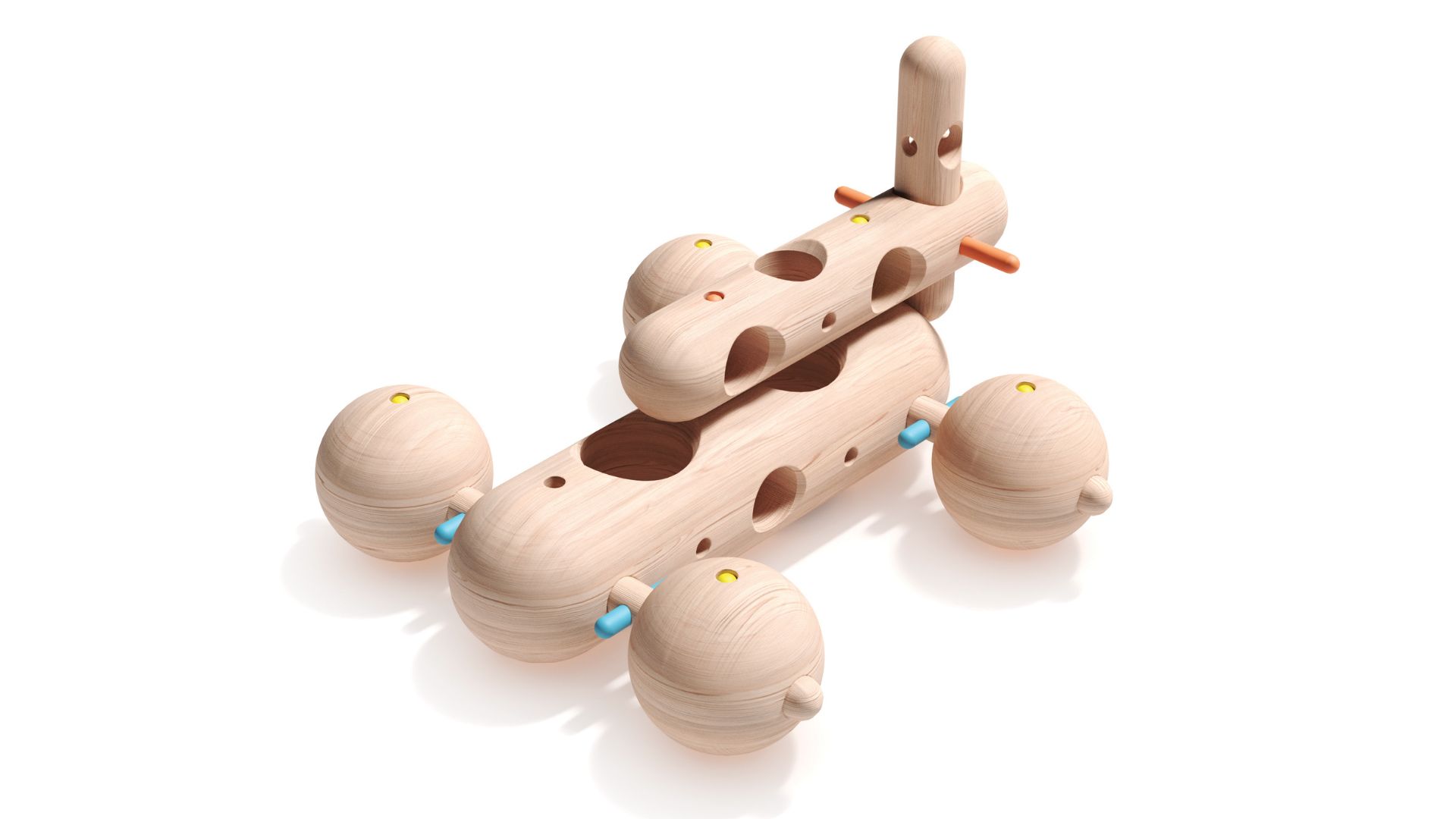
Kavčič Furniture is a family-run workshop in Slovenia that has been crafting solid wood furniture since 1970. Known for blending traditional woodworking with a forward-thinking mindset, the company is now exploring multifunctional design for contemporary living. What follows is a striking example of how design protection can make all the difference. When designer Žan Kavčič exhibited at SaloneSatellite 2025, the Hangy Maxi, a versatile wooden hanging structure developed during his university years, he was approached by a representative from a much larger company. “At first, I was excited to explain everything. Then he told me, ‘That’s infringement. You copied us. Come to our stand and we’ll talk.’” The situation quickly escalated.
The larger brand demanded that Kavčič Furniture remove the product entirely from their booth, including demands for financial compensation and destruction of all remaining stock, and even visiting their stand repeatedly, making threats openly in front of visitors. “It became really uncomfortable,” Žan recalls. “They were coming around and just standing there, watching us.”
Fortunately, the company had registered the design in advance. “We decided to protect it early on because we were aware there were similar concepts in the market.” When the event’s curator learned that the design was officially registered, she connected Kavčič with Salone del Mobile’s legal support. “Immediately she said, ‘They’re in the wrong.’” The legal conversation ended with a single response from the Kavčič Furniture lawyer and silence from the accusers. “If we didn’t have IP protection, even if they didn’t have a case, they could have shut us down. It saved us.”

Apollo Wooden Wheelchair by Paul de Livron
In conversation with engineer and founder Paul de Livron, the Apollo Wooden Wheelchair emerges as both a design innovation and a deeply personal statement. Designed and built by Paul, who is a wheelchair user himself, the chair challenges how people perceive disability.
“One day an old woman came to me and said, ‘Oh, you’re so nice’,” he recalls. “She didn’t even mention the wheelchair. It was just me plus the wheelchair. It changes how people see you.” Made of wood not only for its warmth and visual appeal, but also for its accessibility in manufacturing, the chair reflects Paul’s background in hands-on craftsmanship. “If I knew how to weld titanium, I might have used that. But wood allows me to make a high-performance wheelchair with limited tools.” He explains that the model now being developed hits the right balance between simplicity of construction and overall performance.
Paul is now preparing to travel to Ukraine, where he will build chairs directly in a rehabilitation hospital for patients injured by war. For him, the project is not only about mobility, but also about psychology: helping people refocus, engage their hands, and shift their mindset during recovery.

MONO by Ciarko Design
In conversation with designer Mikołaj Nicer and Zuzanna Ziarko-Gähler from Ciarko Design, winner of the award for the Industry Category, the focus quickly shifted from trends to long-term relevance. The MONO cooker hood was designed with timelessness in mind, prioritizing durable materials, clean geometry, and interaction methods that remain intuitive over time.
Rather than chasing aesthetic statements, the team balanced minimalism with function, combining physical buttons for reliability with advanced gesture control to accommodate real-life kitchen scenarios. Underpinning it all is a strong intention to reposition the cooker hood as more than just an appliance. MONO aims to reclaim its place in the home as a refined, essential, and even expressive design object.
“We want to change the way people think about cooker hoods. For a long time, they had bad PR, seen as ugly, necessary objects. We want them to be functional art pieces,” comments Zuzanna Ziarko-Gähler. Ciarko is pushing to reframe the hood as a designed object, not just an appliance, an example of design elevating the everyday.

The Solar Trees by Fastned
Fastned designs and operates fast-charging stations for electric vehicles, with a focus on speed, visibility, and usability. Their drive-through stations are engineered for quick recharging without parking or maneuvering, making the experience seamless for drivers.
But beyond functionality, design plays a central role in shaping the brand and how people relate to the infrastructure. “Design has the power to bring a very technical environment closer to people,” explains María García Mansilla, Location Design Director. “Instead of staying in the technical dimension, we make it more human and more understandable at a glance.”
The Solar Tree structures, with their bold silhouette and sustainable materials, serve both as charging hubs and architectural landmarks. “You would never take a picture at a gas station,” she says. “But people send me photos of their kids picking flowers next to our chargers. That means we’ve done our job.” Fastned’s visual identity is deeply tied to these structures, which is why design protection is essential. “The design of our stations is our brand,” María adds. “We built the company starting from the architecture. Protecting our image means protecting our identity.”

Bicinete – Cecotec
Cecotec’s finalist product in the 2025 DesignEuropa Awards was born from the intuition to bridge two familiar but distinct worlds: the comfort and geometry of a bicycle with the compact, agile convenience of an electric scooter. “Rosa had the idea to merge the traditional world of the bicycle and the modern world of the kick scooter,” said Jorge Martínez, category manager for e-mobility at the company.
This innovation responded to a real gap in the market, many users found scooters too thin or unstable to feel safe. The new hybrid form factor, lighter and more approachable, proved especially successful in rental and holiday markets, where users are more open to trying new forms of mobility. The design process was challenged by technical limitations around weight, width, and height, issues that were solved through intensive prototyping and internal testing.
On the topic of intellectual property, Cecotec’s team reflected on how the COVID-19 lockdowns became a catalyst for investing in future-focused thinking: “We realized how important it is to invest in R&D and for sure to protect it against competitors,” said Rosa Vidal Romero, product design manager, highlighting the strategic role of IP in ensuring their innovations remain secure in an increasingly competitive sector.