Reading landscape as performance: the work of Cristina Morbi
Maetherea, the name of her studio, is a continuous workshop with nature as co-creator – revealing how science, materials, time, and emotion can shape spaces of observation and understanding of the human condition.
Cristina Morbi doesn’t design gardens, she designs metamorphosis. Born in Crema, educated between Politecnico di Milano and Tsinghua University in Beijing, she now lives and works in London, where in 2018 she founded Maetherea – a manifesto-studio investigating landscape as a living system, capable of responding, evolving, and becoming an author.
Her practice occupies a threshold between landscape architecture, public art, and natural phenomena. She doesn’t seek the definitive form, but the process: each project emerges from a co-creation with natural and artificial agents, where time isn’t decoration but structure. Morbi employs design phenology: a term borrowed from the natural sciences to describe the interconnection between human and natural cycles over time, and how phenology shapes the performative processes of the landscape. For her, design is an interpretative lens, translating seasonal rhythms, erosions, germinations into architectural language.
Gallery
Open full width



Open full width
Alongside her design practice, Cristina Morbi teaches at The Bartlett School of Architecture (UCL), where she leads Unit 7 of the MEng Architecture & Engineering programme, and has been a Visiting Professor at Politecnico di Milano, developing studios on climate change, bio-integrated design, and radical urban landscapes. In this conversation, she reveals how nature isn’t decoration or metaphor, but co-designer: a neutral intelligence that responds to impulses, returns fertile errors, imposes rhythms that architecture can choose to listen to or ignore. And what happens when you choose to listen.
What projects are you currently working on?
Cristina Morbi:
Currently, I am working on two major installations at Silverstone Park, right next to one of the UK’s key Formula 1 circuits – originally a WWII landing strip. The innovation park around it works at the intersection of engineering, technology, and environmental research, so the commission wants to explore nature as engineering. One installation revolves around magnetism: a kinetic system based on opposing poles, with embedded magnets driving motion. It also includes hyperaccumulator plants, capable of extracting heavy metals from the soil.
Your work embraces a romantic view of nature, but also leans on scientific method. How did this approach emerge?
Cristina Morbi:
I’ve always worked in the middle ground. My two Master’s degrees – design and landscape architecture – naturally positioned me there, but there was a turning point when I took a course with Professor Levi, an engineer studying mathematical formulas to describe how surfaces age. That framework clarified something for me. Since then, my practice has focused on assigning design value to processes usually considered outside that field: how time alters materials, how plants grow through light, how so-called randomness follows underlying rules, and I have to say that software often helps expose those patterns.
So these rules become tools for architecture, bridging materials and ecosystems?
Cristina Morbi:
Exactly. That’s where Maetherea comes from. While working in London with Martha Schwartz, I was already exploring these links. Later, a friend from the startup world helped me build a database around them, and we catalogued data from past projects – habitats, materials, plant behaviours, transformations – and mapped out their relationships through matrices.
How central is this cataloguing to your method?
Cristina Morbi:
It’s foundational. In a recent lecture at the Politecnico, I talked about choosing the right language for one’s work. At Maetherea, we don’t say “location”; we say “habitat,” because each site is an ecosystem shaped by human activity, species, and natural processes. A decade ago, during a major mapping exercise, we also stopped calling them “projects.” We began calling them “performances,” because if time becomes a design medium, the result isn’t a static object, but a time-based performance shaped by erosion, layering, germination.
Climate change is accelerating. Your cataloguing once relied on stable site conditions – how is that shifting?
Cristina Morbi:
Climate change is part of the core brief now. Maetherea began with a workshop I ran at the Politecnico di Milano with Martha Schwartz Partners, called Climate Performance. Some of the resulting student work was later shown at the Triennale curated by Paola Antonelli. In the past decade, the shifts have been gradual, but the next decade won’t be.
For instance, one of my latest projects is in rural Indonesia, funded by the British Council of Art, in an area that recently experienced severe flooding. We’ll work with local artists and farmers to document ilmu titen, traditional environmental indicators, through Pranatamangsa, a multi-layered calendar that aligns species behaviour, agricultural practices, and atmospheric signals. Climate change has destabilised its reliability. Signs that once guided sowing – like butterflies or amphibians – no longer correspond to the right timing. A local poem, Rain in June, uses the impossibility of June rain as a metaphor for unrequited love. Now it rains in June, and that shift reshapes ecosystems and culture.
Have you seen climate effects directly impact your installations?
Cristina Morbi:
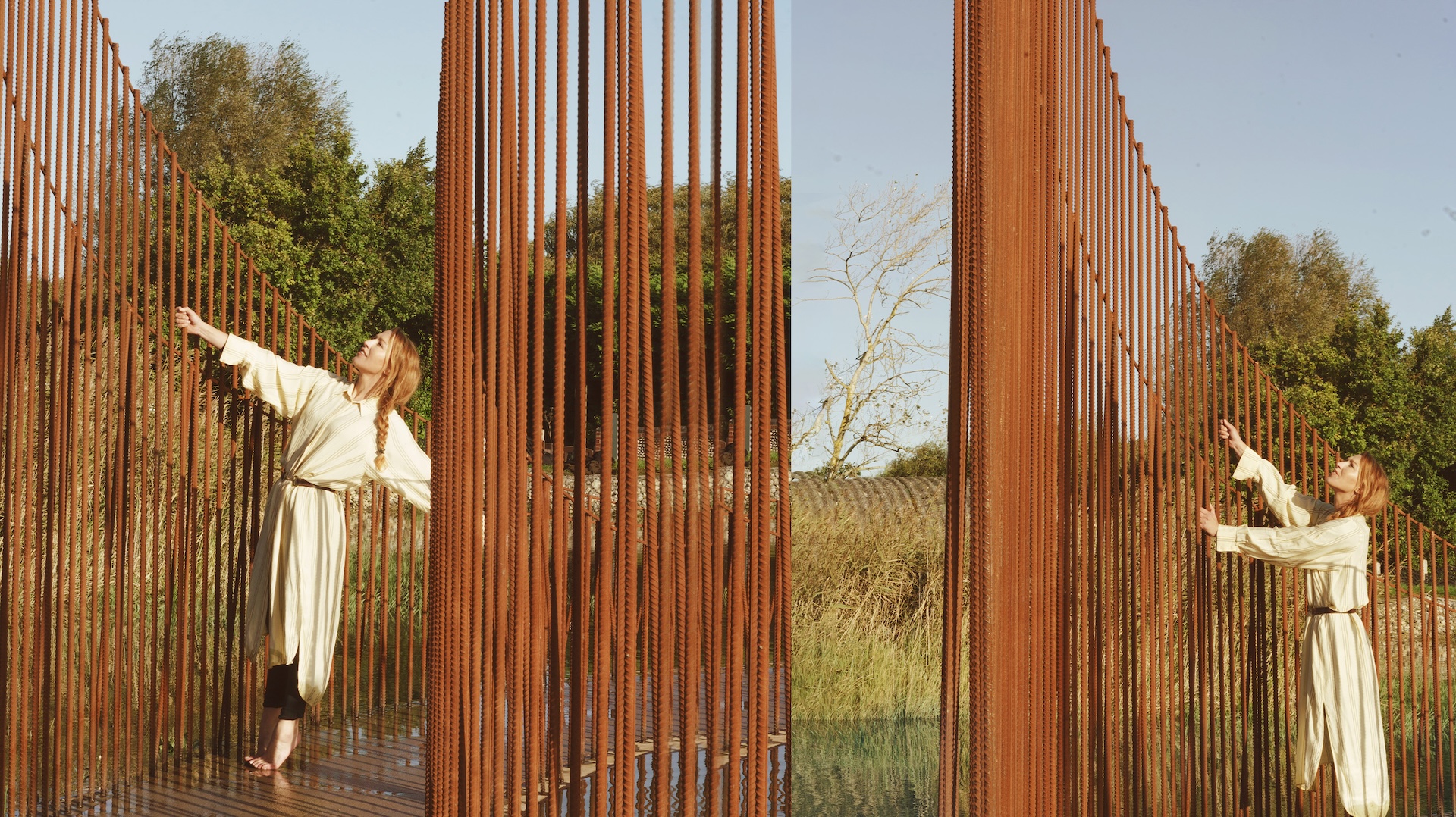
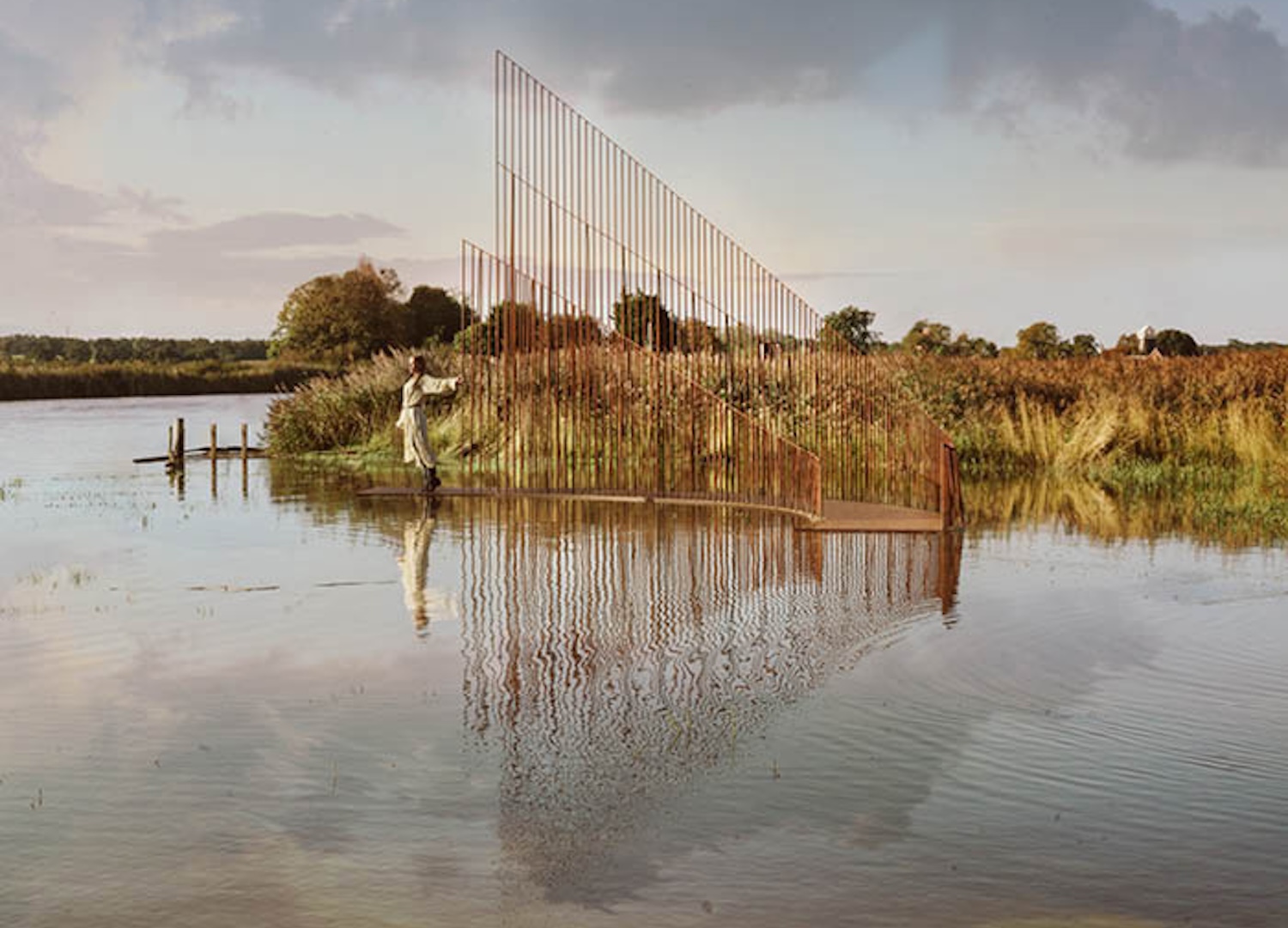
Not now, but I am sure I will. Iron Reef, a nature observatory in Norfolk, is the most exposed because it sits in a tidal zone, and we had to model how it might evolve under climate pressure. We know that salinity will increase, that wind patterns will shift, as is already happening. The UK’s dominant wind corridor – southwest to northeast – has historically shaped entire districts, including the industrial patterns of London. As these dynamics change, so do the parameters for designing with water, salt, and prevailing winds. For the Iron Reef, we studied how the installation itself might morph as these conditions evolve.

You’ve worked in the UK for ten years, but recently in Italy too. How does your approach translate elsewhere?
Cristina Morbi:
Most of my work abroad has been temporary. The UK has a specific mechanism – the 1% rule – that allocates a share of every new development to art, community, or environmental projects. It creates long-term space for experimentation. Outside the UK, apart from China, where I also studied and worked, I haven’t seen the same appetite for permanence or risk.
So what’s missing is long-term investment in experimentation?
Cristina Morbi:
I’d say I haven’t encountered it yet. Though recently I completed three Italian projects in exceptional contexts.
Which of these felt most urgent or aligned with you?
Cristina Morbi:
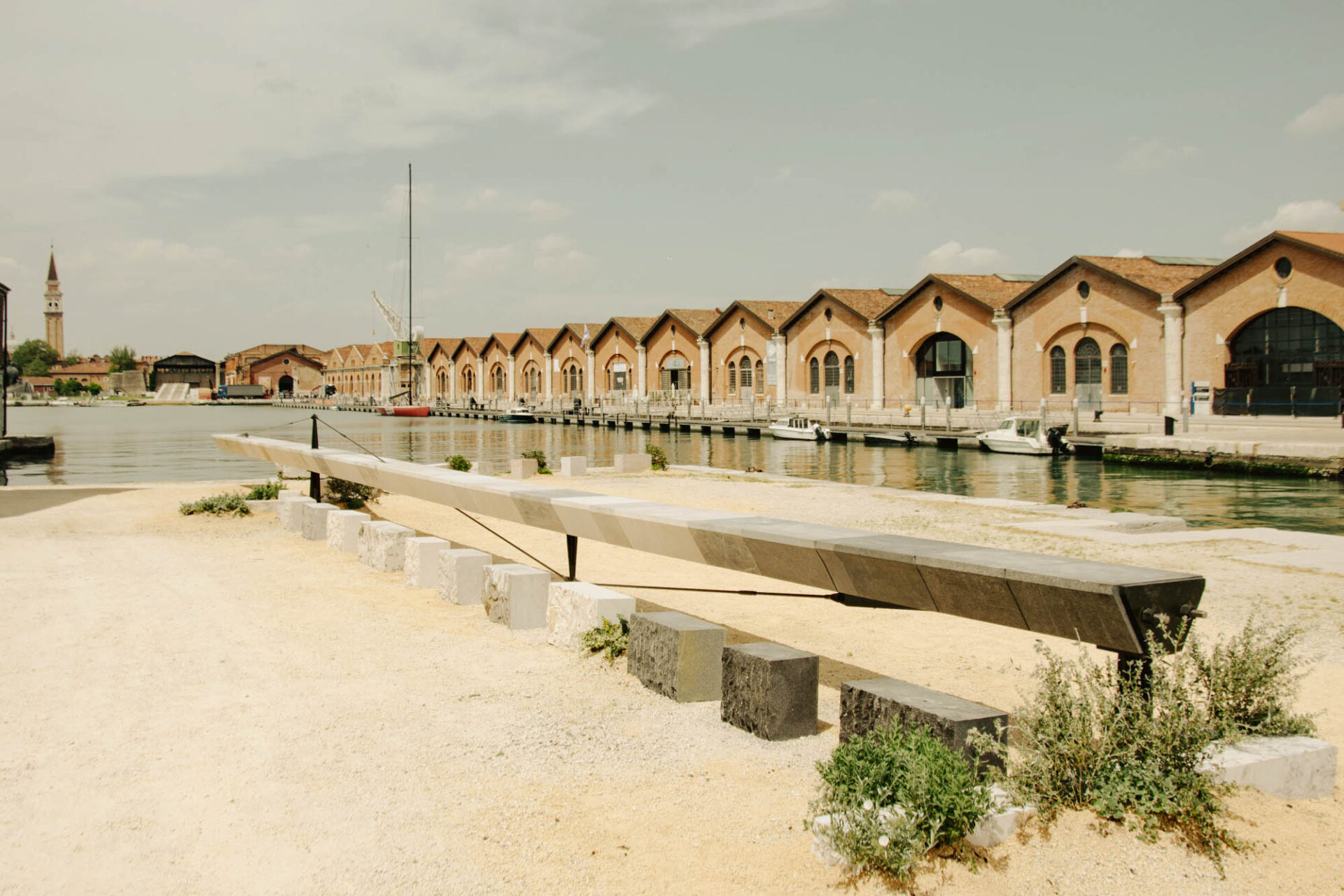
I’m attached to all three, but the one I want to pursue further is the project for ADI (Associazione per il Disegno Industriale) at Marmomac, in Verona: Calligrafie Rurali (Rural Calligraphies), a system of ruderal façades, which uses stone surfaces designed to trap seeds and water, allowing pioneer species – plants that thrive in disturbed, human-altered soils – to take hold. Instead of treating spontaneous growth as a defect, we make the fissure the actual language, we design the cracks. We design bioreceptive surfaces, this time in stone rather than concrete, because we reflect on stone’s relationship with water, where actions like absorption and filtration open up a lot of potential.
How much does unpredictability matter? Even with models, it seems to push new ideas forward.
Cristina Morbi:
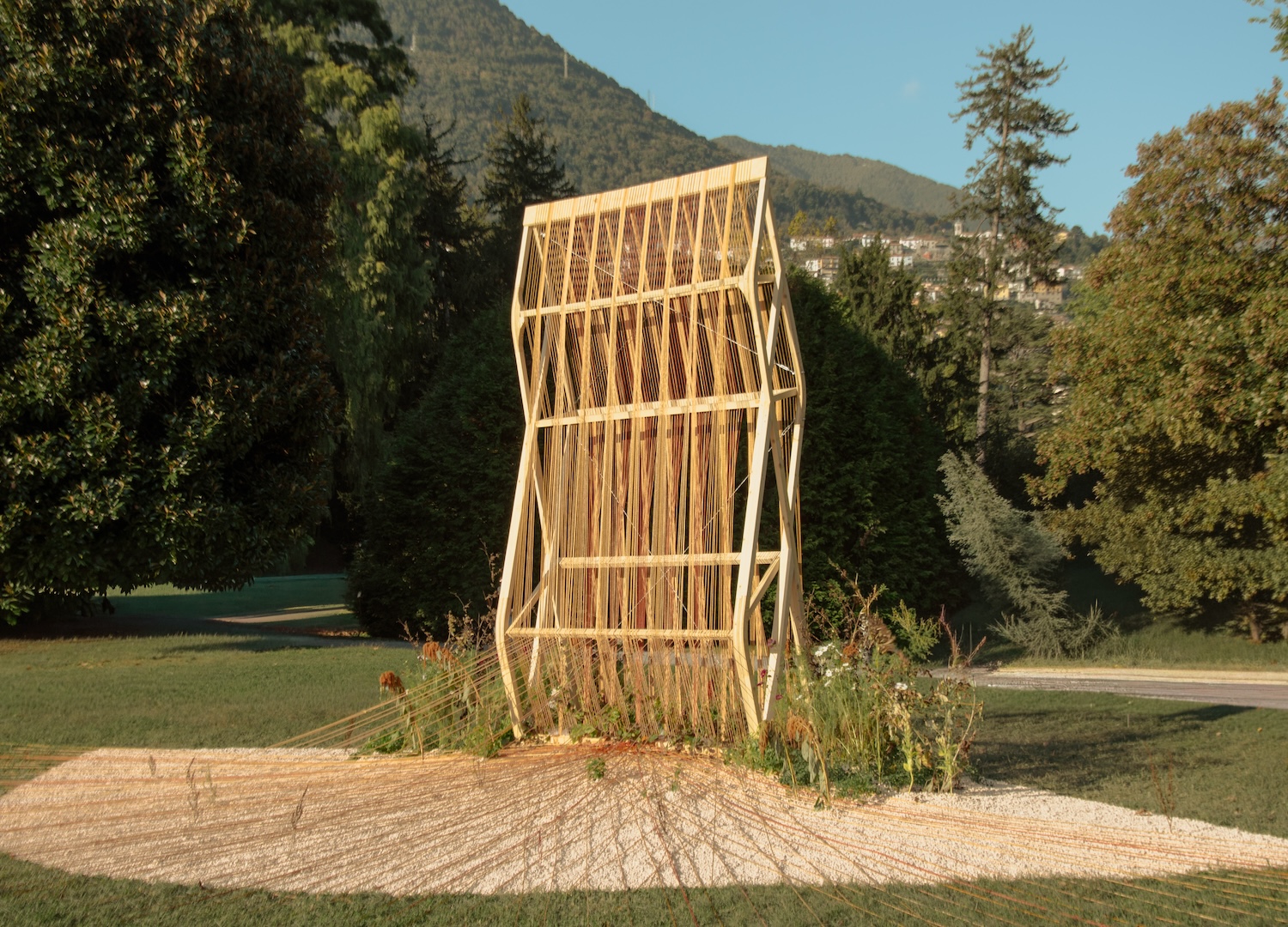
It’s essential. Mistakes often trigger the next step. At the Biennale, the installation’s “errors” directly informed the Marmomac façade. Another case: in Austria, I accidentally left a specific project uncovered. That oversight became the basis for Understory – Tapestry of the Unseen, at the Orticolario in Como, where a meticulously designed Persian-tapestry layout was eventually altered by plants emerging through it. Unpredictability exposes the limits of rules, and those limits are productive.
Nature becomes a co-designer, with its own pace and logic.
Cristina Morbi:
Nature is neutral. It reacts to what we propose. You can resist that reaction, or you can work with it.
And you’ve chosen to work with it – turning data into experience. How do you feel about your work now
Cristina Morbi:
It’s a good phase. I’ve had others, but what encourages me now is the interest and enthusiasm from students, especially around my work. For example, they ask me a lot about Tapestry of Biodiversity, where I developed a kind of brick that is ephemeral, that sounds like a contradiction. Made from a material used as a nutritional supplement for birds, the bricks are literally consumed: they dissolve, enrich soil with calcium, and restore minerals in areas affected by acid rain. Students respond strongly to this idea of reversible, nutritive architecture, and, honestly, I plan to keep developing it.
Which parts of your research could influence mainstream architecture? What should architects focus on
Cristina Morbi:
At the Bartlett, where I teach, we work on the idea of architecture’s “bone structure”: the structure as mineral matter and the skin as potentially ephemeral. But we work on longer timelines – around 50 years. So, understanding material evolution is fundamental. How do we design for disassembly? For material afterlives? Which layers are durable and mineral, and which can return to organic cycles? If architecture is a body, its layers operate on different timescales. Internal partitions change often and don’t need high durability. The structure, the skeleton, must endure.
About the author

Ludovica Proietti, journalist, design historian and curator, teaches in universities and curates events, always exploring projects with fresh, unconventional perspectives.
Instagram