10 designers and studios with a distinct vision
10 visionary designers and studios that each day actively redefine design through approaches rooted in sustainability, high craftsmanship, and production innovation.
Over the course of 2025, we explored and interviewed a range of remarkable creative practices at DesignWanted, highlighting, among others, 10 whose work stands out for their determination, ingenuity, deep study of form and materials, and their ability to see far beyond the finished object.
From experimental textiles and circular furniture systems to immersive botanical installations and transformative spatial design, each practice reveals a distinct vision: one that challenges conventions, rethinks materials, and embraces circularity not as a constraint or unresolved problem, but as a deliberate, forward-looking design strategy.
Gallery
Open full width

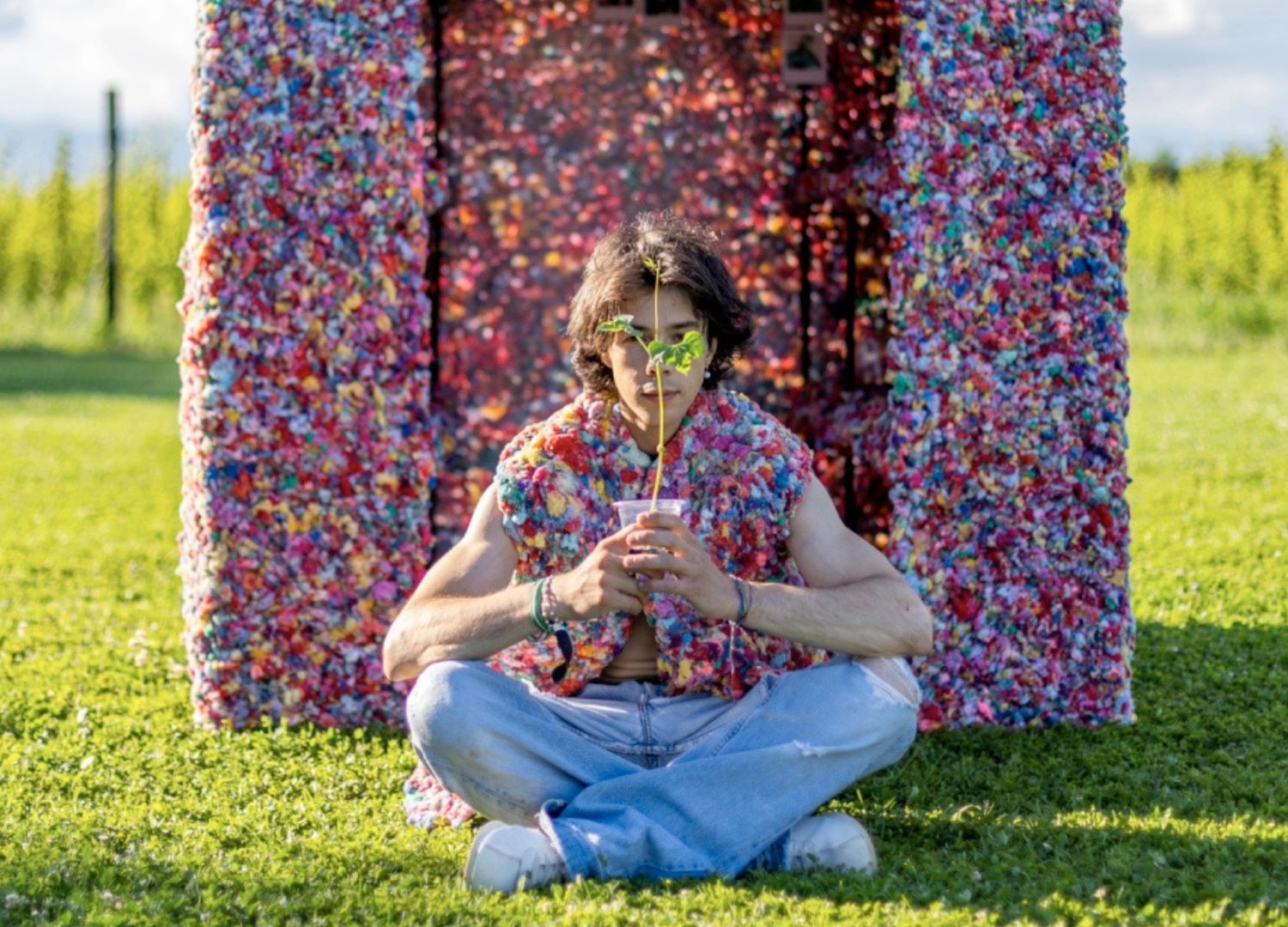
Open full width
We’ve brought them together here for you. Dive in and enjoy exploring the innovative work that is redefining the world of design.
10 designers and studios to follow:
CECILIA RINALDI
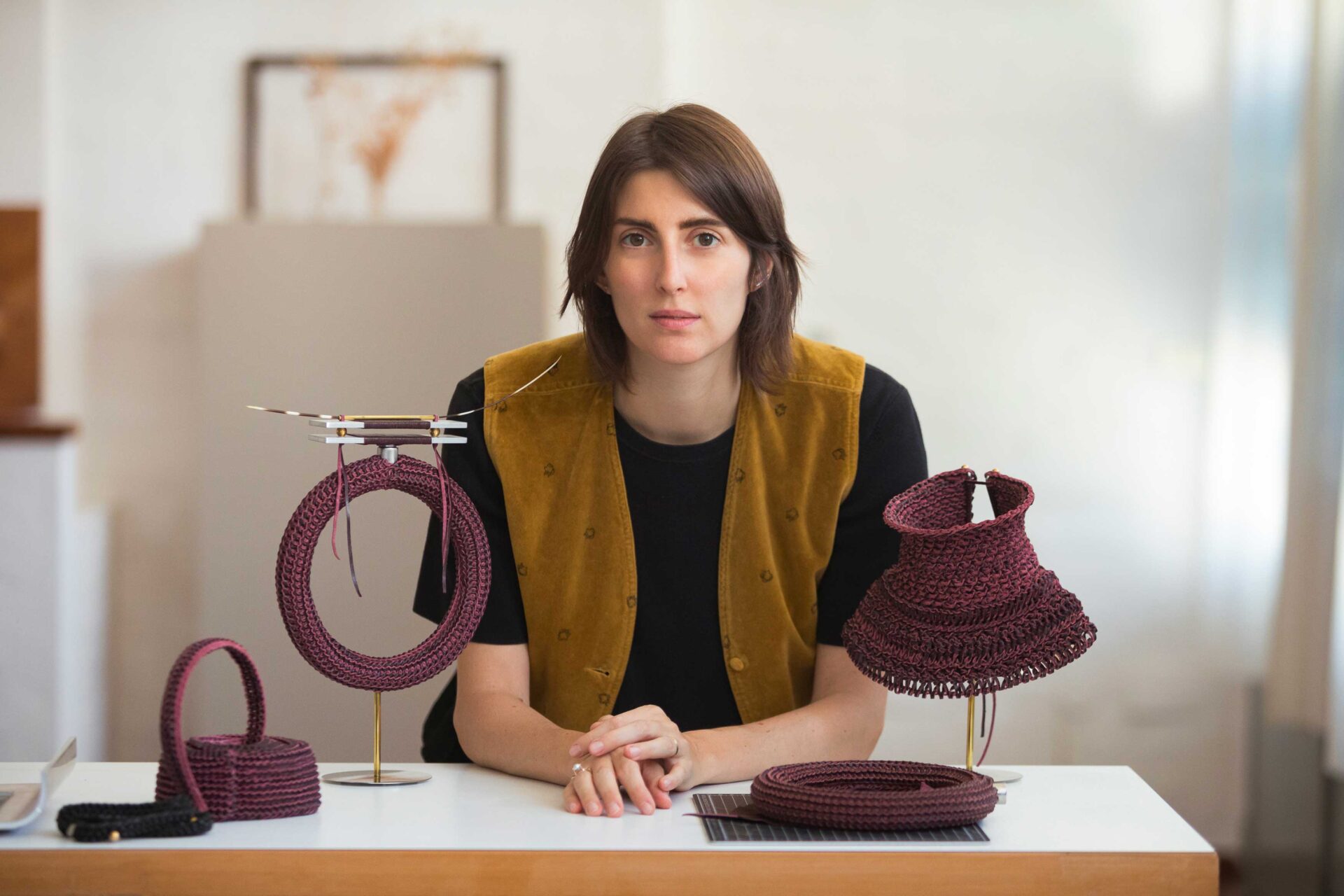
Founder of Atelier Nuanda, Cecilia Rinaldi is an Italian textile designer and artist whose creative language is almost impossible to capture in words. Yet, leafing through—or even just glancing at—the works of Atelier Nuanda, from accessories and garments to decorative objects and furniture, four words naturally rise to the surface: delicacy, elegance, care, and a gentle sense of intimacy.
Working across multiple creative fields—fashion, decorative arts, product design and set design—Atelier Nuanda was born from the desire to give new form and expression to a cherished legacy: “the expressive character and refined elegance that my mother exuded in her every gesture, expression and scent. Each project in the atelier is intended to be a way of telling her story through my creations, in the hope of reviving emotions that are now only distant memories,” Cecilia tells us in an interview. Alongside this noble intention lies another: preserving traditions by delving into different worlds, cultures and philosophies, and bringing ancient techniques and decorations into the present.
Her woven-leather technique is a striking example of this approach. Recovered from industrial surplus, the leather is transformed into a textile-like weave and crafted into artefacts and accessories—a tribute to the ancient gestures of knitters, reinterpreted with contemporary sensibility. The MT55 collection is Atelier Nuanda’s foundational project and the fullest embodiment of this narrative: a series of refined ornamental garments in which woven leather becomes both structure and surface, and whose aesthetic stands as a symbol of inner strength, beauty, tenacity and femininity—the portrait of a woman who, even from afar, continues to inspire the works of Atelier Nuanda and Cecilia Rinaldi’s gestures.
STUDIO DOUZE DEGRÉS
A French design studio, Douze Degrés, moves within the liminal spaces that connect multiple worlds: from scenography to installations, from set to product design, from art direction to museography. And it is precisely the blue hour—the transition between day and night, when the sun sits between –6° and –12° below the horizon, douze degrés, indeed—that reflects the studio’s method.
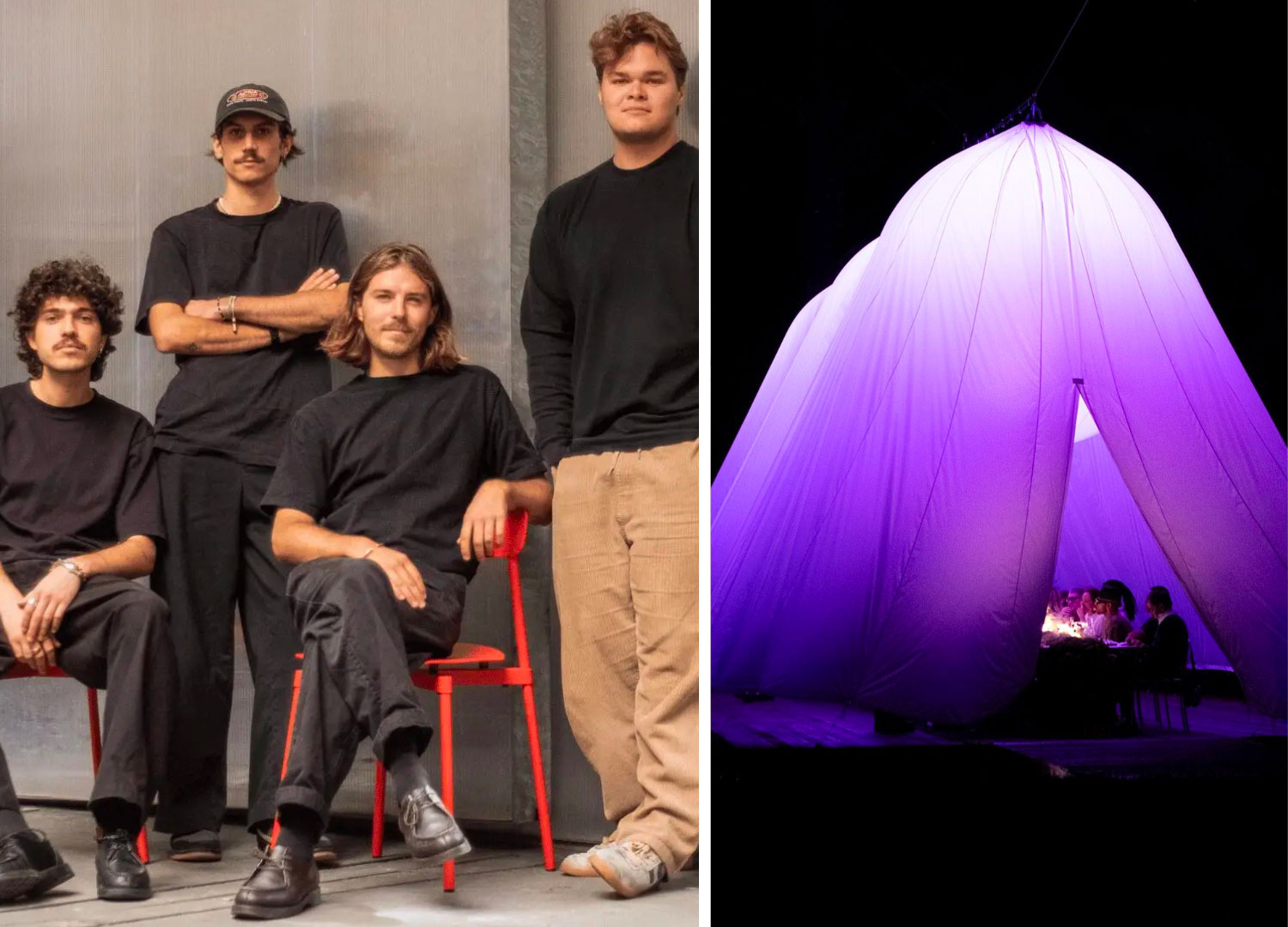
For Douze Degrés, designing (spaces, products, services or more) means creating experiences, moments of awareness, spaces for dialogue, and places of conviviality. Design is not a tool that simply produces finished objects, but rather one that gives shape to experiences built through interaction. This becomes especially evident in their scenographic and set or space-design projects. Consider the Caron Diner, created for the launch of Musc Oli, the new fragrance by Maison Caron: a 20-meter textile structure suspended in the heart of a forest that appears from the outside, at night, like a lantern or a luminous woodland creature, while inside its long table—made from fallen trees and dressed with moss and wildflowers—becomes a setting where design, nature, and perfume frame guests in an almost dreamlike moment of conviviality.
To this immersive dimension, the studio adds a remarkable ability to create spaces and installations that are not only guests of the places they inhabit, but also transformative agents—sensitive, skillful interlocutors. With gentleness and respect, they complete and enrich landscapes and surroundings. Such is Frame, a set-design project created for Cercle: a scenography at 3,464 meters on the Sphinx Observatory, conceived to engage in dialogue with the light and high-altitude landscape, evolving in step with natural shifts of the sun’s glow.
ANTOINE SEGUIN
Antoine Seguin—a French designer trained in industrial design—is convinced that although we live within a system largely based on the mass production of short-lived products, sustainable innovation is not only possible (and necessary) but achievable on a global scale. Local approaches, methods and knowledge can be translated into industrial processes, bringing innovation and sustainability not only to the choice of raw materials but to entire systems of production, distribution and product use. How? Through design.
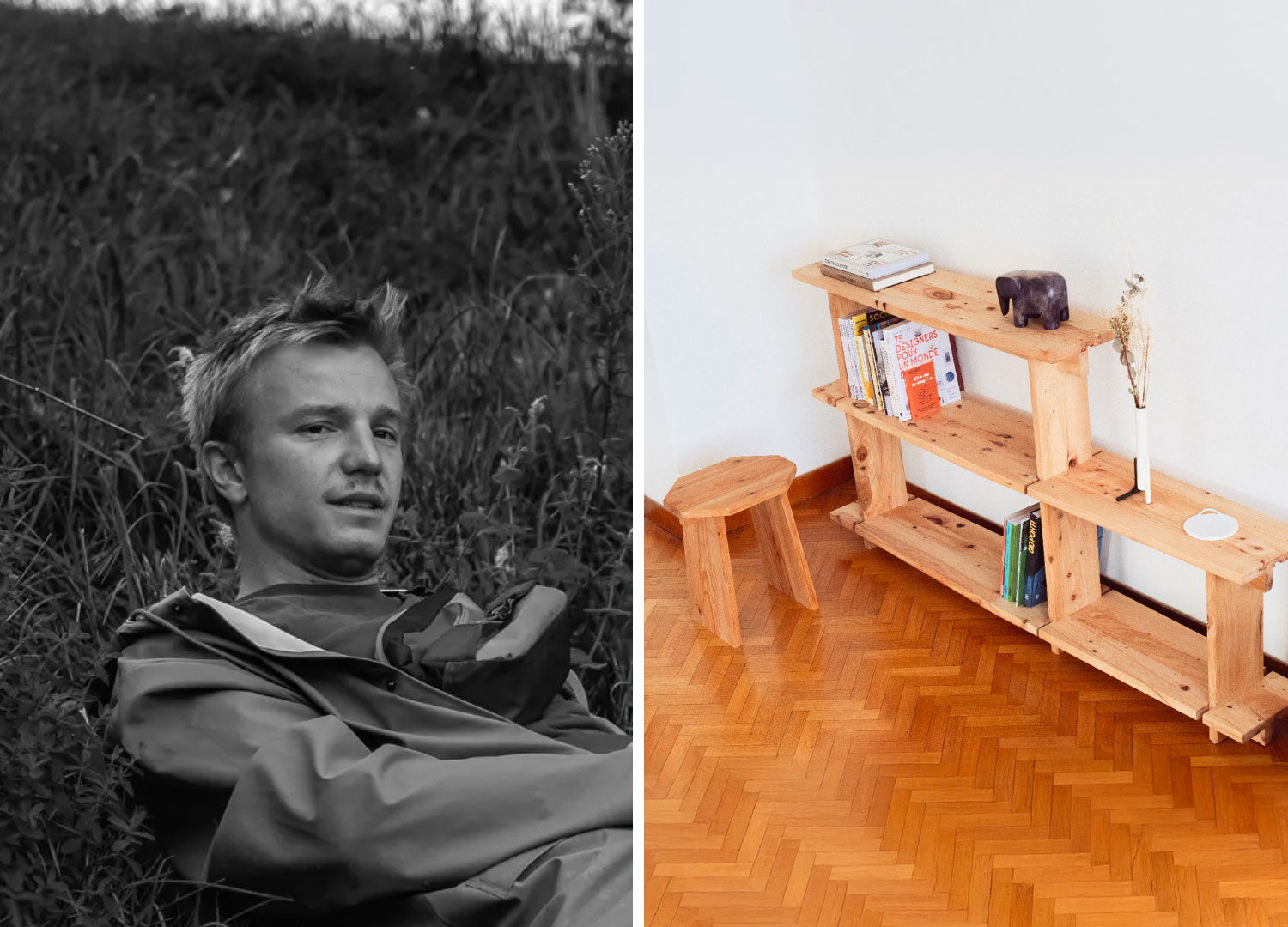
What defines Antoine’s design approach is, first of all, an absence: the deliberate removal of anything unnecessary. In his hands, a table, stool or bench doesn’t need screws or nails to hold together; it simply needs components shaped so precisely that they slide into place and lock through their own geometry. This idea comes to life in Acampa, a collection of furniture inspired by the landscape he comes from and crafted using local cedar and cypress from the Luberon.
Stripping objects down to their essential elements means establishing a production—and consequently consumption—system in which waste is significantly reduced, and circularity emerges through modular products that can be endlessly reconfigured. Antoine does not apply this approach only on a small scale. Collaborating with major companies such as Shiseido and Decathlon, he first helps them understand the social and environmental impact of their sector, then outlines a new direction that uses the core principles of sustainability and circularity as strategic and competitive advantages.
MAREEN BAUMEISTER

A needle, a robotic arm, and mountains of discarded sheep’s wool: this is likely what you will encounter upon stepping into Mareen Baumeister’s studio. A multidisciplinary designer, Mareen has transformed an ambitious research project into a decentralized, replicable production system. Nearly 90% of sheep’s wool in Europe is burned, buried, or otherwise discarded. Coarser than other natural fibers, it finds little demand within the fashion industry. Faced with these figures, Mareen Baumeister chose to reintroduce wool to a different market: design. Her project Flock recovers waste wool and transforms it into a structural material through a robotic felting process.
By using a robotic arm equipped with a felting needle and precisely controlling the machine’s speed and intensity, Mareen is able to create rigid, fully functional, monomaterial objects. A tangible outcome of this method is the Flock Stool—a piece of furniture made without adhesives or synthetic reinforcements and therefore not only functional, but also fully recyclable, renewable and biodegradable.
Furniture, however, is only the starting point. Flock lays the foundation for a new production system that brings together advanced technology, craftsmanship and sustainability. One designed to be reproduced locally and potentially extended to other fields, from architecture and interiors to, perhaps, infrastructures.
DAVIDE BALDA
Archeodesigner—this is how Davide Balda defines himself. Being an archeodesigner means tracing the geographical origin of matter, studying the place that holds it, rewriting its meaning, and designing by manipulating materials as if they were the rubble and residues of the contemporary world. The waste produced by the textile industry is undoubtedly among the most imposing forms of contemporary debris, and it is precisely from this that Davide began developing Telare la Materia, a project created during an artistic residency at Fabrica, the Benetton Group’s research center.
As frightening or unsettling as it may be, we are all more or less aware of the environmental impact of our choices and habits—yet we rarely stop to imagine the future of the countless products that crowd shop displays. Davide Balda had the courage to do just that and Telare la Materia is his response to the unbearable image that gradually took shape in his mind. Scraps, remnants and excesses from the textile industry are transformed into both synthetic and organic fibers, and these fibers, in turn, become raw materials for structural, load-bearing components, new products and furniture, and even fertilizing substrates.
With a dramatic yet necessary bluntness, Davide describes a world in which “companies base their business system on a capitalistic economy, poor in culture and human values.” And yet, with refined intelligence and rare foresight, he constructs a new one—built on the true circularity of matter.
ARTHUR MOULUCOU
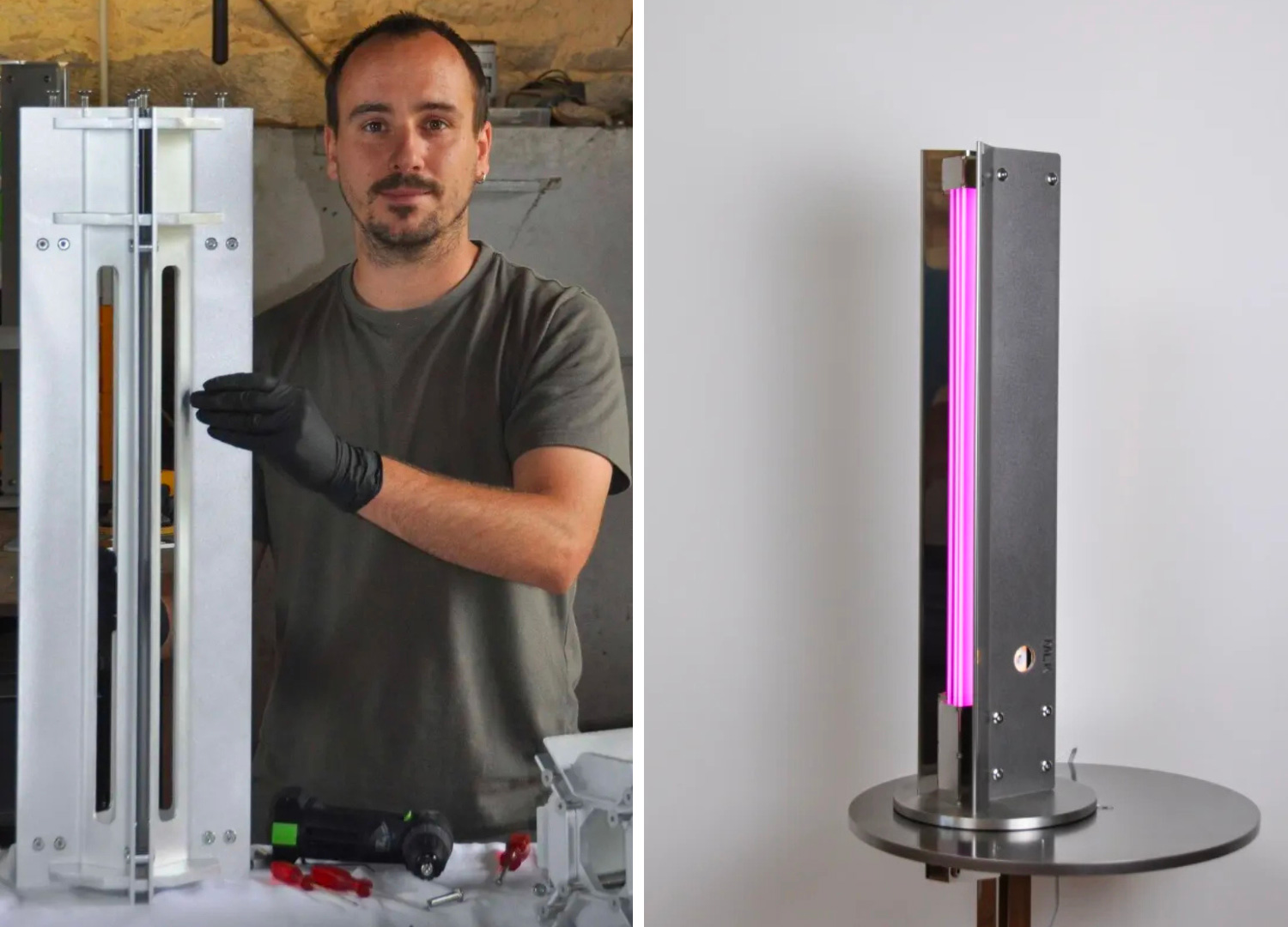
At times brutalist, undeniably futuristic, and with a distinctly industrial aesthetic, Arthur Moulucou’s works are produced in his small self-run workshop, MLK Furniture. Trained in architecture in Bordeaux, Arthur draws his inspiration from a city Arthur finds his inspiration in a city entirely unlike any French city: Bangkok, a city he calls a “neon paradise”, alive with vibrant energy, neon lights, and nights that never sleep. It was here that Arthur developed his signature “sandwich design concept”, a method that encloses the components of an object between two metal plates, simplifying assembly while ensuring repairability and longevity.
Among the projects created at MLK Furniture, the NE600/145 lamp and the D300 shelving system stand as clear manifestations of his low-tech design philosophy. The lamp transforms an industrial lighting system—the neon—into a luminous sculpture, while the shelves turn laser-cut waste into a modular storage system. Both projects perfectly embody the spirit of MLK Furniture: structural simplicity, aesthetic rigor, and zero waste.
FELICIA NEUHOF
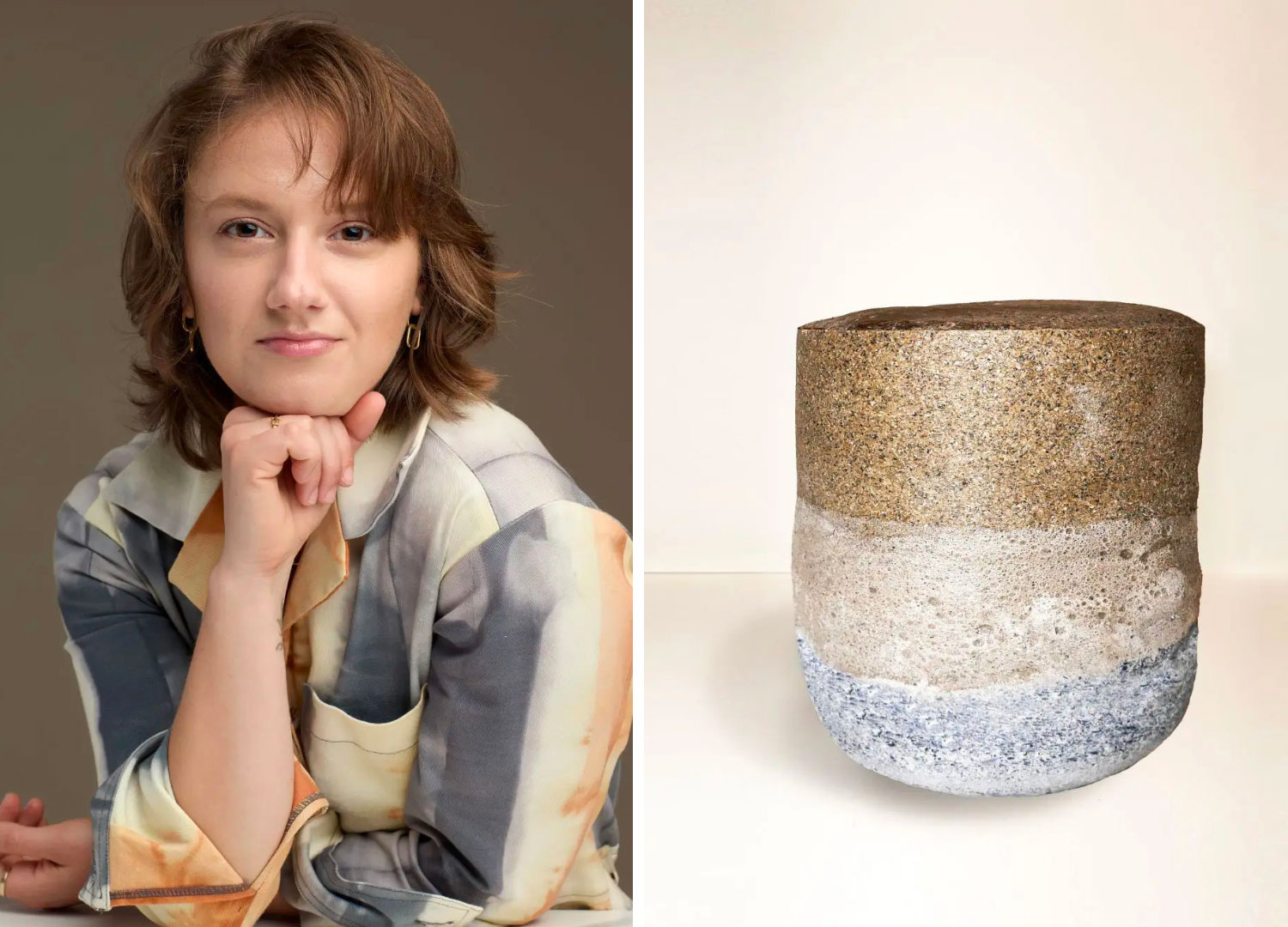
Raised in an environment where nature and human life coexist seamlessly—on a 15-acre farm in rural Woodstock—Felicia Neuhof, founder of Shellf Life, has translated into her practice what only such a setting could teach her: the ability to listen, to observe, and ultimately to harness the inherent intelligence of natural materials. This instinct trains a designer not to force matter into predetermined frameworks and to rethink the very idea of failure as an invitation to listen more closely.
Such is the case with Buoy, the stool Felicia presented at the latest Milan Design Week. Made entirely from discarded shells, Buoy conveys something profound and—without indulging in unnecessary romanticism—quietly moving: giving a material that, in common perception, has reached the end of its life a second chance, a potentially infinite one. Through continuous adjustments and shifts in her process, Felicia gradually uncovered the distinctive properties of shells, qualities that serve both functional and experiential purposes.
The result is a product that honors the material to its fullest, including in its aesthetic dimension. This is why she chose not to use dyes, allowing the natural hues to emerge instead: “Different species create these distinct tones—oysters have this pearlescent quality, mussels bring in blue-grays, and clams offer warmer tones. The ocean already created this perfect palette,” she explains.
LILO KLINKENBERG
“Creativity often flourishes under constraints, and I’ve learned to adapt and find solutions.”
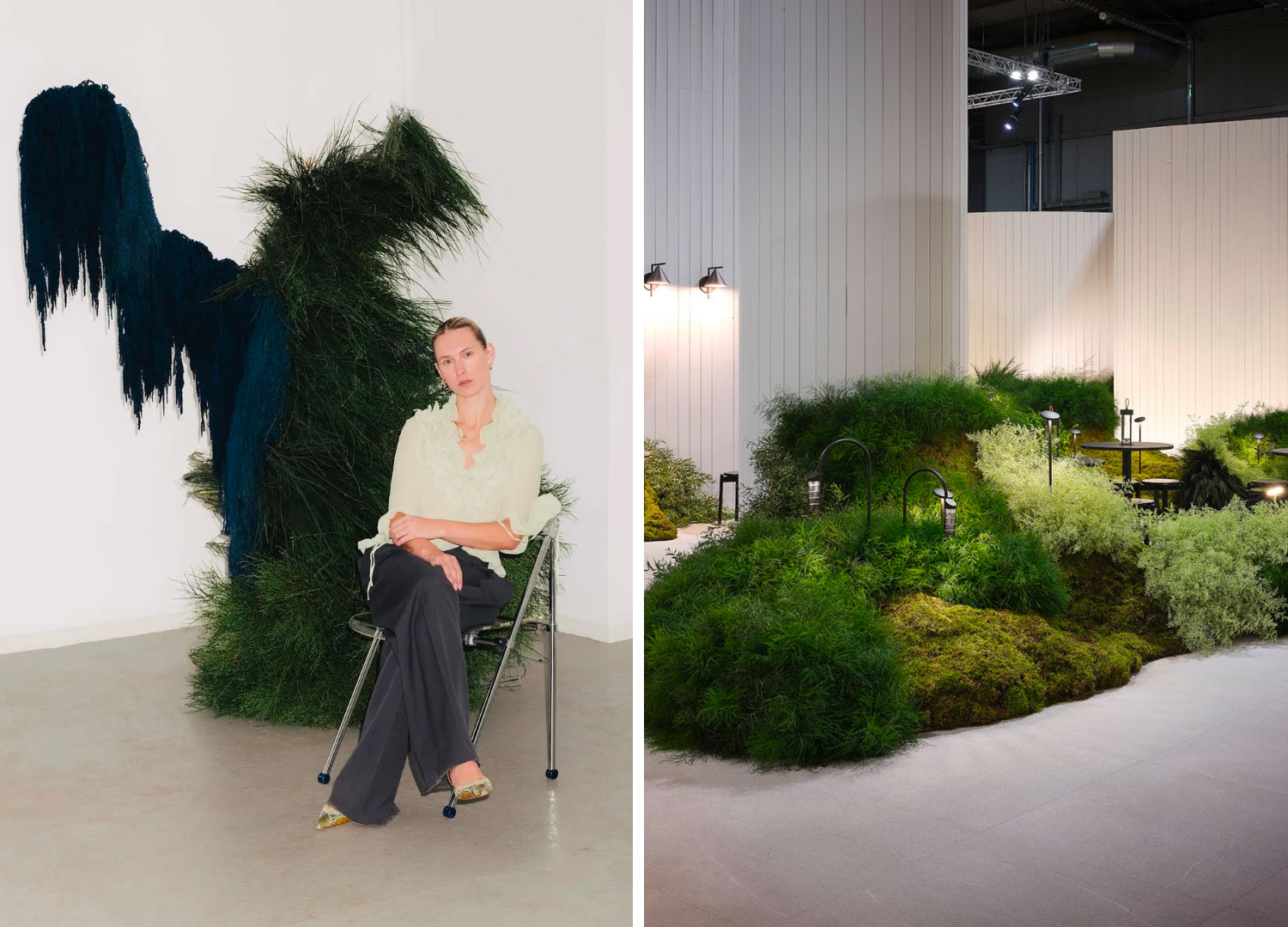
The constraints Lilo Klinkenberg, founder of the Berlin-based Studio Lilo, refers to are more concrete than ever. Specializing in botanical design, floral design, and spatial art, Lilo works closely with nature to create installations and sculptural works, inevitably following the rules dictated by the seasons, climate changes, and the geographical contexts in which her projects come to life.
The botanical installations of Studio Lilo—ranging from ephemeral works for high-profile events to permanent sculptural pieces—elevate contemporary floral design to an extraordinarily complex, profound, and poetic art form. Daily encounters with nature’s unpredictability constantly challenge Lilo’s creativity, revealing not only new, invaluable secrets of the natural world but also reveal new dimensions of her own creative self.
Her installations, sculptures, and site-specific works—often inspired by the daily interplay between nature and urban life, particularly in Berlin—transform the spaces that host them into living artworks. These environments evoke deeply varied emotions depending on the viewer, sometimes surprising even the artist herself, who experiences her own creations taking form in unexpected ways.
ABUSE STUDIO
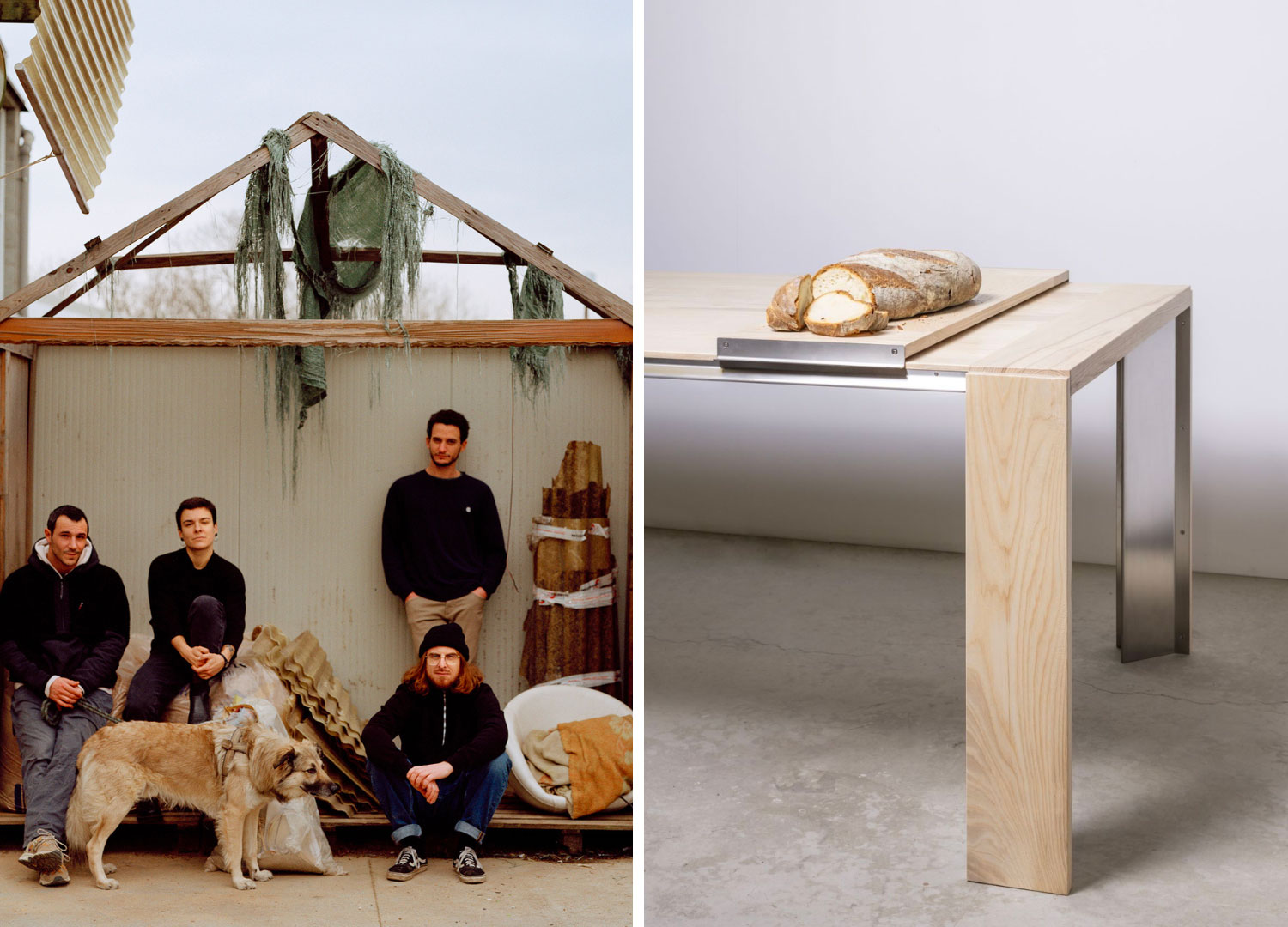
An Italian design studio and woodworking workshop, Abuse Studio embraces a hybrid model of practice that allows for full, continuous control over every stage of the process. Michele Chillé, Andrea Favalli, Sara Vaccari and Michele Zadra bring together visions and expertise rooted in different backgrounds—architecture, urban planning and design—shaping a shared, multidisciplinary approach.
Hybridisation lies at the core of the studio’s identity, with projects ranging from interior and product design to installations. Abuse Studio works primarily with local resources, consistently seeking to minimise material use through essential construction techniques. This approach is clearly expressed in the 1000 series, presented at Fuorisalone 2025: four pieces—a bookcase, a table, a seat and a modular shelving system—crafted from solid wood sourced from nearby forests in Lombardy and Piedmont.
Finished with linseed oil to enhance its natural character and paired with steel to reinforce the slimmer wooden sections, each piece is designed according to principles of material essentiality, employing ingenious technical solutions that also allow for modularity. Together, these choices reflect a design philosophy rooted in restraint, craftsmanship, ingenuity and profound attention to details.
COSTANTINO GUCCI
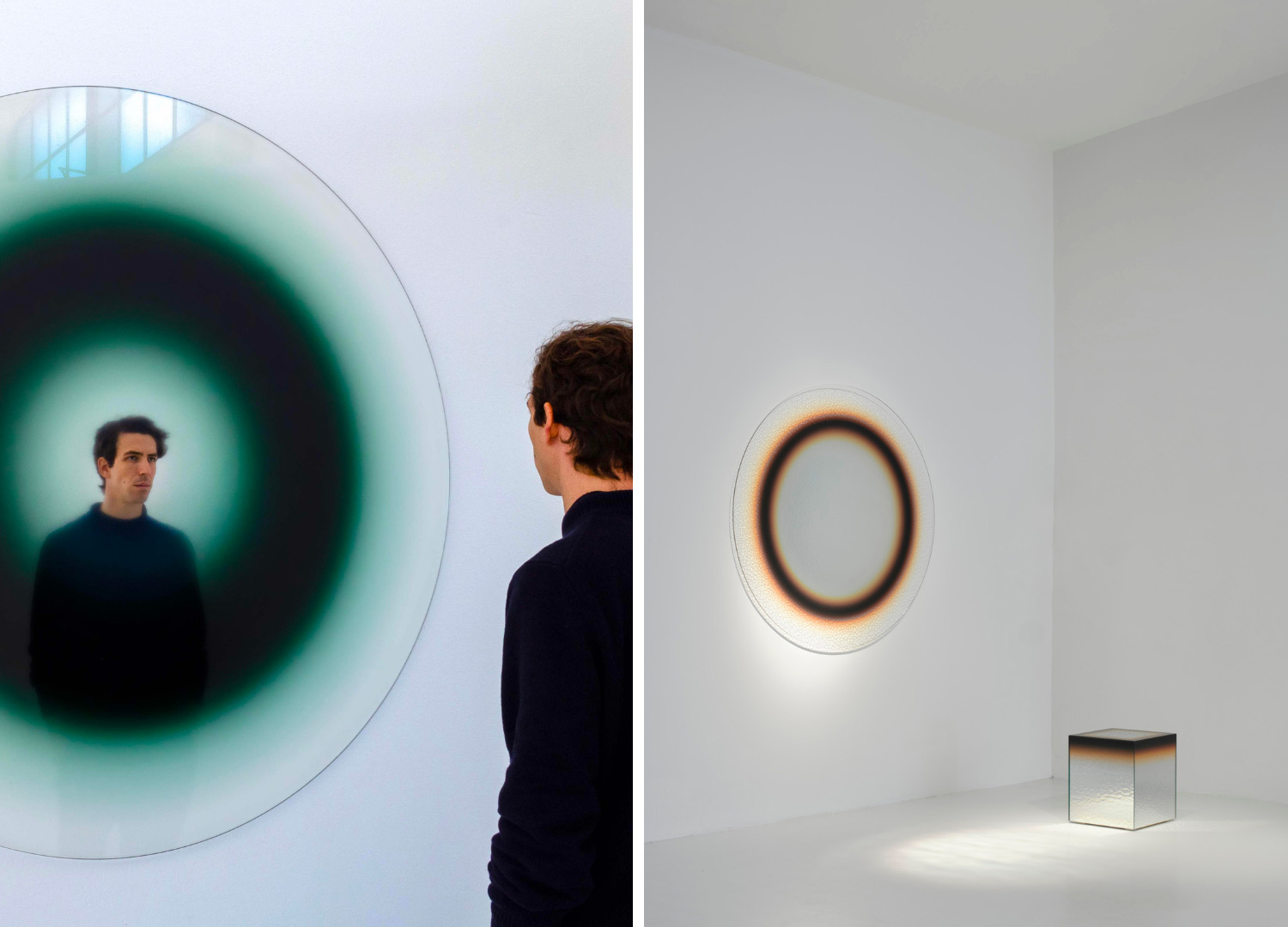
Interacting with Costantino Gucci’s works means engaging in a delicate—yet extraordinary—process of recomposition and introspection. An Italian designer and artist, Costantino works with reflective materials such as glass and mirrors, as well as photosensitive inks, to create pieces that define and complete themselves through their relationship with space and with the viewer. His works—that began with mirrors and have recently extended to tables and coffee tables—while reflective, never return a complete image of their surroundings. Instead, they fragment, blur and deconstruct reflections, challenging ideas of stability, accuracy and boundaries.
“I no longer speak of reflected images, but of physical presences in a space to interact with,” Costantino Gucci explains on the occasion of his first solo exhibition, Self Reflections. The show brought together ten works created exclusively for Milan-based gallery Movimento, all investigating reflection as an unstable, ever-evolving phenomenon. True “portals to be crossed,” the works generate a dynamic and deeply personal experience for each individual, compelling viewers to continuously shift their perspective in an attempt to find themselves within the reflection, only to recognise themselves along the shifting edges of the works.