Paris Design Week 2025 regenerated its roots, shaping a new wave of research and trends
At its 15th edition, Paris Design Week spotlighted a creative vanguard of talent and unfolded as a platform of international exchange, where design became a dialogue shaping the city.

Paris Design Week 2025 transformed the French capital into a citywide celebration of creativity from September 4 to 13. The event, part of the Maison&Objet fair, once again, affirmed its role as a mirror of contemporary design, spanning disciplines from collectible furniture and architecture to fashion, craft, and new technologies.
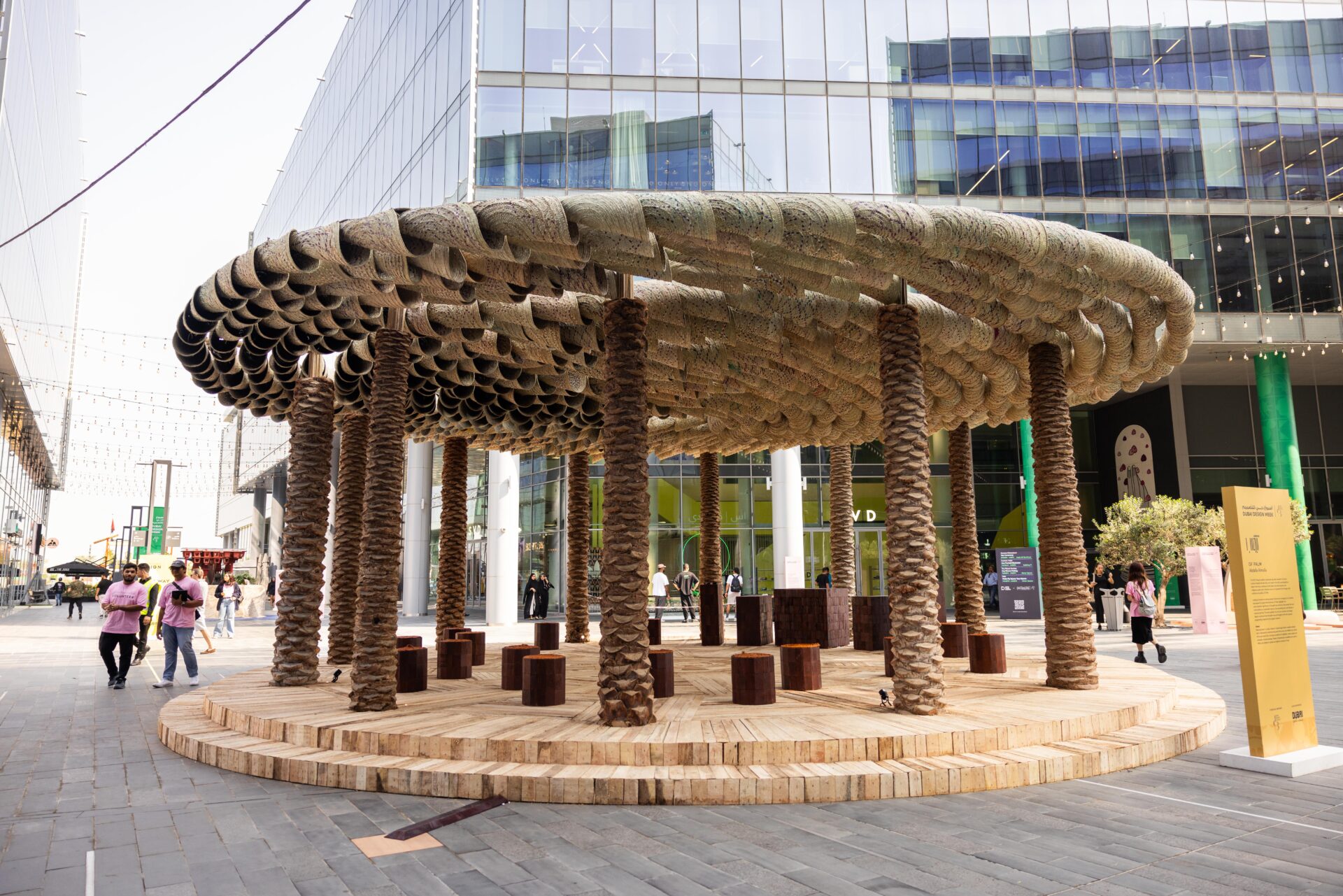
This 15th edition demonstrated with renewed clarity how daring and distinctive French design can be, while also underlining its international scope. Paris became the epicenter of this collective exposition, the stage where the spirit of exchange and transformation unfolded—not only through galleries and objects, but also by granting access to rarely open sites, such as the historic Colonne de Juillet at Place de la Bastille. Here, a monumental installation took shape: soaring textile works in linen fiber, by Aude Franjou, redefined the landmark with a striking artistic gesture.
Gallery
Open full width


Open full width
Projects of this kind also reflected how this year, Paris Design Week, in synergy with Maison&Objet and its theme Renewal, explored the idea of Regeneration, highlighting design’s power to address cultural, environmental, and social challenges through cycles of transformation and reinvention. Both events shared the mission of spotlighting a rising generation of talent, positioning them as the new barometer of emerging trends.
The Paris Design Week Factory, the hub that shines a light on a fresh wave of designers whose practices and references are original and unexpected, now in its second edition, presented a diverse landscape of ideas, reflections, and experiments shaped by the acceleration of technology. Curated once again by Jean-Baptiste Anotin and Thibault Huguet, founders and creative directors of Meet Met Met – the non-profit collective created in 2022 that aims to bring together and promote the new international design scene – the Factory set out to fuel the conversation in design with a critical and radical stance, where the thrill lies in twisting, reframing, and redefining the world and its perceptions.
In the lively Marais district, the Factory unfolded as a journey, showcasing eclectic, forward-thinking explorations of materials and conceptual research across four locations: 17 rue de Commines at Espace Commines dedicated to collectible design; 7 rue Froissant, with a special focus on Chinese design, hosting the third edition of China Creative Pavillion; 116 rue de Turenne at Galerie Joseph, hosting the exhibition The Future of Craft; and 84 rue de Turenne, presenting a survey of international design projects. Here is a selection of notable examples of this contemporary approach, which we found in the French capital:
Paris Design Week 2025 – Highlights:

Knot Stool by Studio Yann Gandon & Maxime Sauce
Knot Stool by Studio Yann Gandon in collaboration with Maxime Sauce challenges the way we think about structure, function, and the role of the user. Instead of relying on screws or glue, the stool is held together entirely by ropes, tightened through a series of carefully designed knots. The laser-cut aluminum frame serves as a minimal skeleton, but it is the tension of the cords – vividly colored in purple, yellow, and grey – that gives the object both stability and character. By shipping flat-packed and requiring the final knot to be tied by the user, the project transforms assembly into a participatory act: completing the stool becomes a small ritual, a moment where the maker’s hand meets the designer’s intention.

Fauda by Olivier Requier and Lumix by Pablo Sinan Akgül
At Galerie Joseph, two emerging voices decided to come together to stage a dialogue on transformation and continuity. Olivier Requier, with his first furniture piece, Fauda, presents a shelf whose tubular metal frame draws from the language of scaffolding – structures that embody preservation, change, and growth. Raw yet refined, its glass platforms and reflective surfaces turn matter into metaphor: a discreet construction that guards memory while asserting a bold physical presence.
Alongside, Pablo Sinan Akgül showcased Lumix, a minimalist lamp inspired by the multiplicity of urban cultures. With its interlocking, hand-finished base and recyclable polycarbonate shade, the lamp reinterprets the hearth as a contemporary meeting point, where light fosters dialogue and exchange. Together, shelf and lamp become more than functional objects: they act as cultural anchors, a modern fire and a guardian of meaning, reminding us that even in times of rapid metamorphosis, the home endures as a space of refuge and identity.

Gleaning the City by Phèdre Barbas
This research-driven project by Phèdre Barbas reconsiders copper as both a ubiquitous urban material and a carrier of layered social narratives. By collecting and reworking discarded fragments from the city, the practice turns the act of gleaning into a form of appropriation – transforming the trivial into the precious.
Copper, here, is seen as the “veins of the city”: a substance tied to survival economies as much as to centuries of refined craftsmanship. The project probes the tension between utility and value, common object and artifact, while raising urgent questions about our right to the city – who shapes it, how it evolves, and what role making and remaking play in that process.

Flare by Douze Degrés
Flare is a lighting collection that revisits one of the oldest sources of illumination – the candle – through the lens of optical research. Inspired by maritime lighthouses, the project transforms a modest flame into a signal of unexpected intensity. An optical lens captures the candlelight, amplifying and projecting it so that a soft, intimate glow becomes a radiant beam.
By shifting scale and perception, Flare turns a domestic ritual into an almost architectural gesture, where light functions not only as atmosphere but as a marker of presence. Both poetic and technical, the work by Douze Degrés reflects on how design can elevate the ordinary needs into a poetic gesture.

Soft Objects by Gaspard Fleury-Dugy
Textile sampling here is not simply a technical exercise but a way of thinking, an ongoing dialogue between hand, machine, and material. Each knitted fragment is like a wave – unique yet inseparable from the one before it – echoing Calvino’s vision of the sea in Mr. Palomar. The knitting machine becomes both pen and partner, translating thread into a choreography of needles, yarns, and gestures. This practice, grounded in the repetition of 3D knitting, builds a personal archive of forms, textures, and color harmonies, a vocabulary that expands over time like a living ecosystem.
At once postmodern and elemental, the work by Gaspard Fleury-Dugy embraces paradoxes: industrial technology reimagined as craft, rigid mechanics softened into organic shapes, the precision of production intertwined with the spontaneity of nature. Stray threads scattered on the ground resemble seaweed washed ashore, while each new sample feels like a trace of an evolving landscape. Beyond its poetics, the project also affirms the environmental potential of 3D knitting, a virtuous process without material waste.

La Labo 1.0 by Baguette Studio
This project rethinks consumption by making industrial processes local, transparent, and adaptable. Centered on a lighting system made from 100% natural wax, the collection – table lamp, wall light, and pendant – can be fully reshaped on-site in under 45 minutes using rotational moulding – as Baguette Studio did during the design week, in a show that made the crowd assisting part of the process.
Each lamp evolves through local micro-production, while its stainless steel base can be reused in other objects. Le Labo 1.0 envisions an ecosystem where material life cycles are waste-free and production becomes a visible, sustainable, and participatory experience.

Bal Tash’rit Collection by Emma Batsheva
Guided by the precept “do not waste”, this furniture collection by Emma Batsheva rethinks how natural materials are valued and preserved. Italian vegetable-tanned leather and American walnut – often discarded for imperfections – are meticulously laser-cut into interlocking fragments, making full use of each surface.
The result is a modular system where durability, comfort, and craftsmanship converge, turning precision technology into an ally of tradition. Bal Tash’rit transforms what could be waste into purposeful, elegant design, creating objects that are at once functional, sustainable, and poetic – a tangible reflection of care for material, process, and environment.

Arceo Flow by Studio Joachim-Morineau
Arceo Flow is a design effort in terms of experimentation: an object that explores light, fluidity, and movement through sculptural luminaires that trace the elegance of a freehand-drawn line. Thermoformed plexiglass tubes encase 360° LED neon, set into precision-machined aluminum bases, creating pieces that float between drawing, installation, and functional light.
The series by Studio Joachim-Morineau merges French poetic craftsmanship with Dutch experimental sensibilities, producing luminous objects that engage architecture, enhance space, and transform light into a sculptural, fluid experience.

Prisma by Studio quiproquo
Prisma reimagines obsolete LCD screens as sculptural objects of light and reflection. By repurposing optical films from discarded monitors, Studio quiproquo transforms electronic waste into pieces that play with transparency, color, and materiality.
Each work captures and refracts light in unexpected ways, turning what was once considered obsolete into a source of visual poetry. Beyond its striking aesthetics, Prisma reflects a sustainable approach to design, questioning value, utility, and the creative potential hidden in discarded technology.
About the author

Ludovica Proietti, journalist, design historian and curator, teaches in universities and curates events, always exploring projects with fresh, unconventional perspectives.
Instagram