Reclaiming public spaces: when urban design becomes political
By subverting the neglected corners of a city into new uses, Leopold Banchini’s Round about Baths transforms them into places of gathering and collective care.

Modern cities are often hostages of the car, filled with functional infrastructure that is not accessible or useful to pedestrian citizens. What was once a shared playground for the public is now dotted by obstacles: traffic islands, roundabouts, narrow pavements all represent lost opportunities for the city’s wellness and social life. Round about baths is a public work where Leopold Banchini addresses this challenge, reclaiming these urban islands for public community use.
The project, created for the 2025 Concéntrico festival, addresses a peculiar urban character: the roundabout fountain that sits in the middle of traffic, visible to all yet accessible to none. On a semi-circular fountain surrounded by roads near Logroño’s city centre, Banchini has built a temporary bathhouse and steam for the people to use, in free 45-minute slots. At the heart of the roundabout, people can now gather, undress, and relax.
Gallery
Open full width


Open full width
Through a circular structure entirely encloses the fountain, the architect has created a calm and quiet social space that distances itself from what urban life usually looks like. The work is made of raw timber and unfinished wood panels, speaking a language of temporality and re-use, alluding to the replicability of the work in other urban areas. After the installation closes, these materials will find a new life, while the roundabout will return to its uselessness, leaving behind an emptiness to who has experienced its possibilities.
The work is inspired by the historical presence of public bathhouses, buildings where people could go to bathe, socialise, and relax, which existed as an attempt to improve public hygiene and health. In the last two centuries, public baths have closed their doors, slowly replaced by private wellness centres. In this context, Round about baths also mirrors Finemateria and Studiolatte’s recent work Bagno Diurno, where they reopened one of Milan’s oldest bathhouses as a new social scenario, celebrating body care and collective life.

Urban spaces are “third places”, a term which refers to the social surroundings that are separate from the environments related to home and work. Sociologist Ray Oldenburg argues that third places are fundamental for democracy, civic engagement, and a sense of place. The decline in the accessibility of these spaces in the last few decades has created a gap, where the only spaces designed for lingering and socialising are private, commercialised, and exclusionary.
The challenge of reclaiming urban space extends beyond simple physical accessibility, it is about cultivating safety, appeal, and serving real community needs. When architects and designers are successful in transforming these overlooked spaces, they create a stronger and deeper relationship between citizens and their land. These actions make the difference between feeling like you belong in a space, or feeling like you are an unwanted guest there. When public life is relegated to scattered benches and the occasional patch of green, the message is clear: keep moving. As anti-homeless architecture is on the rise, all citizens can feel the city’s hostility.
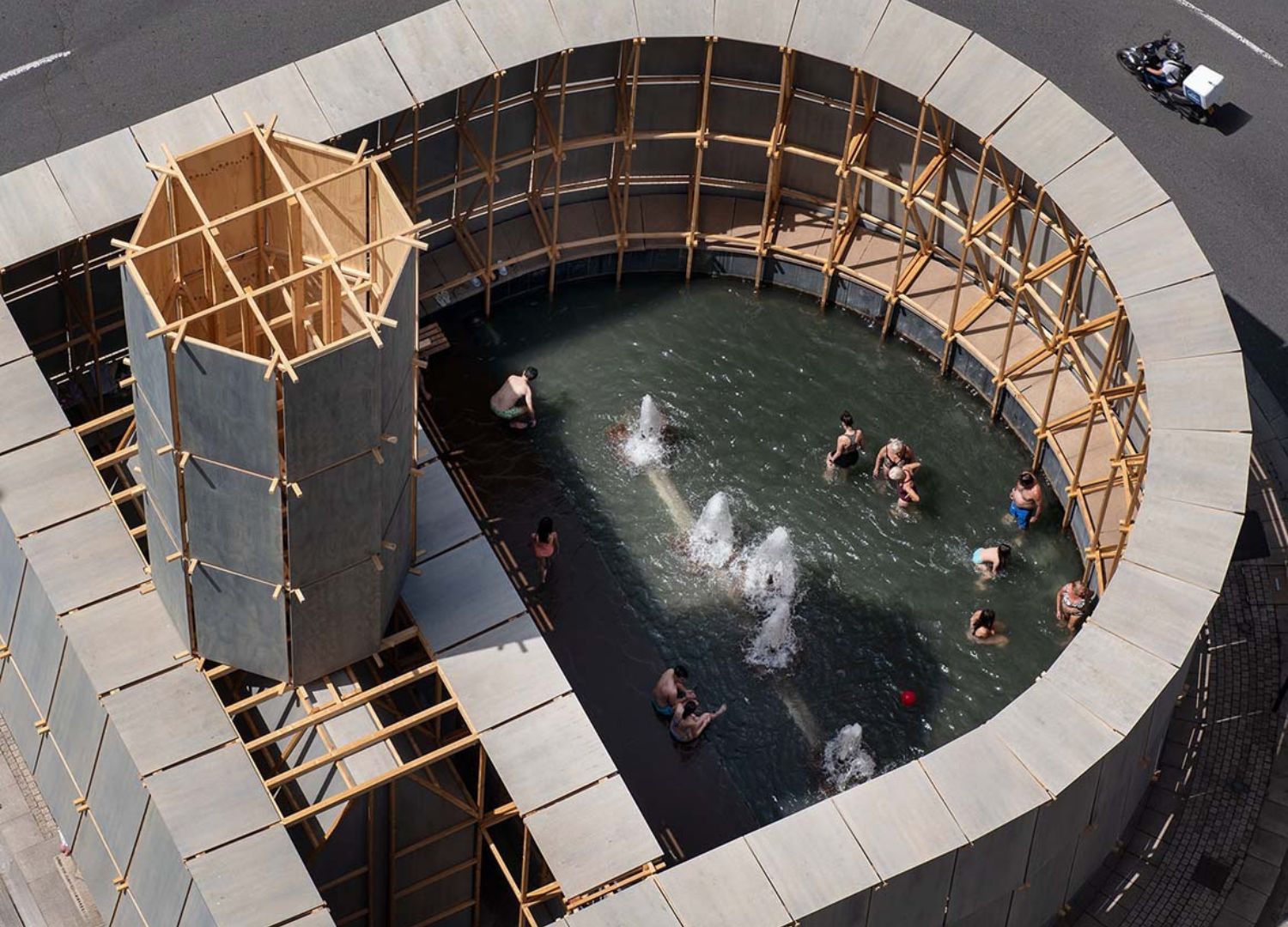
Round about baths is a reminder that the city belongs to who lives in it. With minimal design and creative thinking, Leopold Banchini managed to transform an ignored roundabout into a community asset, proving that these interventions do not have to be expensive or invasive to be effective. Exposing the absence of inclusive public spaces, Round about baths confronts the systems that consistently privilege efficiency and profit over citizen welfare and collective life. If even a roundabout can become a place of belonging, what excuse do we have for our cities being so unwelcoming?