What happens to a material once it has been labelled as waste? Can its identity be changed, and can design play a role in that transformation? These are some of the questions at the heart of Red Mud, an ongoing material research project by Studio ThusThat.
Before aluminium becomes an actual metallic material, it begins its journey as bauxite, a naturally occurring red ore. Through the refining process, alumina is extracted, leaving behind a substantial quantity of residue known as red mud. For every part of aluminium produced, more than 2.5 parts of red mud are generated. Despite its enormous scale, red mud’s negative impact remains largely invisible in everyday life.
Studio ThusThat’s response is to approach this residue from an unexpected direction: ceramics. Investigating the material’s potential in its own right, the designers explore how it can be processed, formed, and fired into ceramic bodies, while its high oxide content offers possibilities for developing special glazes.
The resulting collection of vessels and tableware proposes a different relationship with an otherwise stigmatised material. While industrial production is associated with scale, efficiency, and extraction, ceramics introduce another language: one of tactility, fragility, detail, and craft. We spoke with Paco Böckelmann, the studio’s co-founder, about the research process behind Red Mud, the art of ceramics, and how our contemporary society can value waste.
Table of Contents
What initially drew you to bauxite residue as a material for design exploration?
Paco Böckelmann:
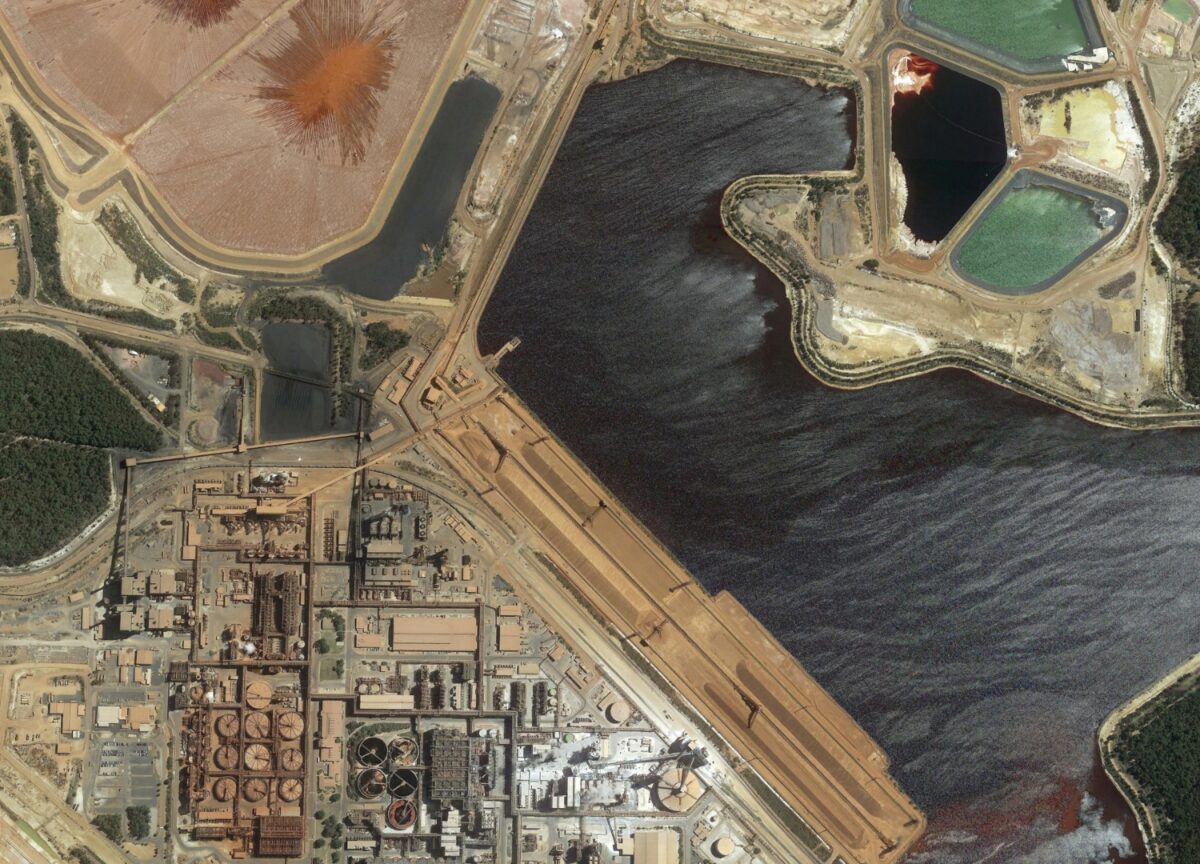
“It started with aluminium. At the time, aluminium was being presented everywhere as the material of the future: lightweight, essential for electric vehicles, and infinitely recyclable. We wanted to know where it actually comes from. Following it back through the supply chain to the alumina refineries, we came across satellite images of their residue sites. They were stunningly beautiful, a little eerie, and very, very red.
That red is bauxite residue, or “red mud,” the byproduct of refining bauxite into alumina, the precursor to aluminium. More than 150 million tonnes of it are produced every year, and almost all of it simply sits in vast storage sites.
What surprised us most was how much research already existed. Scientists have been looking for uses for red mud for more than a century, and the residue is already described in Carl Josef Bayer’s original patent for the process. There are over a thousand patents on the subject, yet only a few percent of it is actually used. This was before AI tools, so Google Scholar became our best friend. Much of the research pointed towards bricks and cement. Bricks, we realised, are essentially ceramics: a craft none of us had any experience in, but a lot of curiosity about. That was our starting point.”
What were the biggest technical challenges in transforming red mud into a ceramic material? Were there any unexpected discoveries during the process?
Paco Böckelmann:
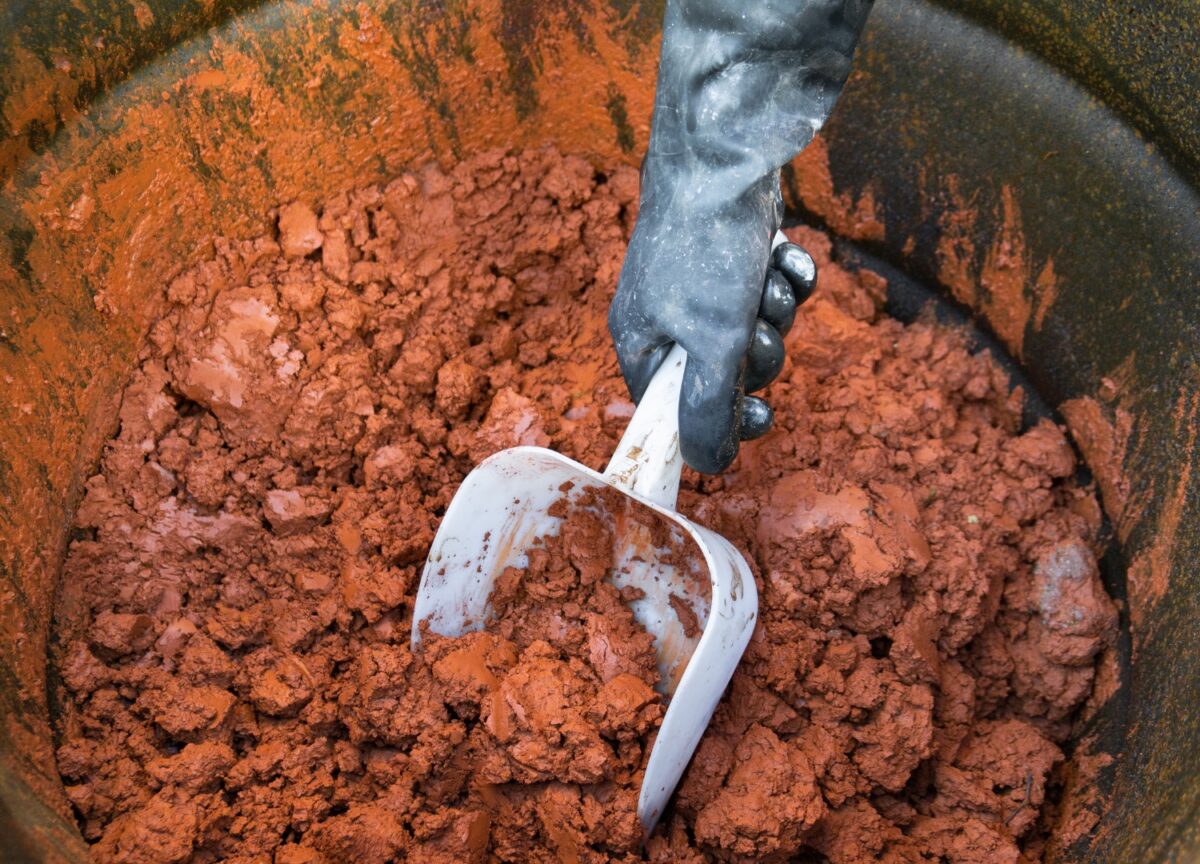
“Workability, by far. Anyone who has worked with regular clay knows its silky, soft, plastic feel. Red mud has very little of that. It cracks, shrinks, warps, and generally refuses to hold the shape you give it. We ran endless tests and dug through traditional ceramics literature to find the right additions to make it sinter properly in the kiln and behave more like a conventional clay.
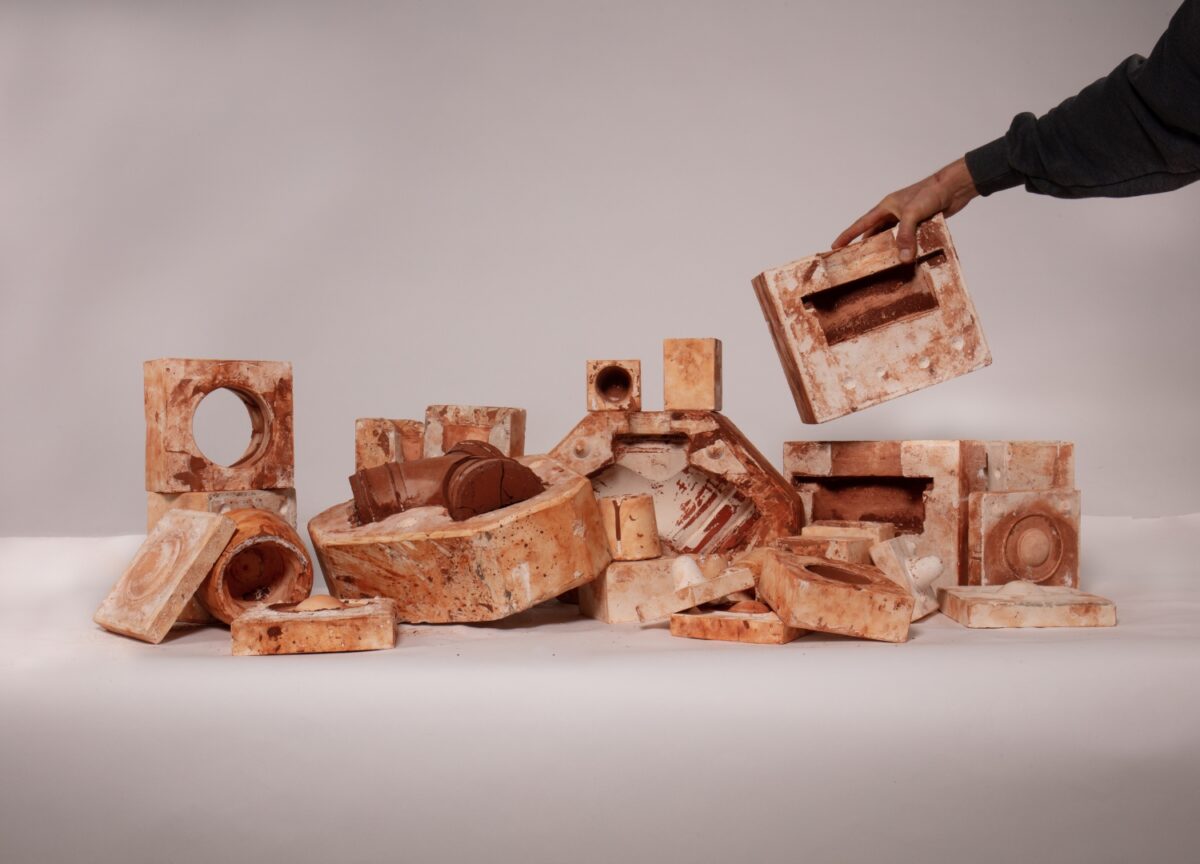
That lack of plasticity is also why we turned to slip casting, pouring the material as a liquid into plaster moulds instead of throwing or hand-building it. The limitation became a design opportunity. Slip casting let us make sharp, precise geometries that reference the chimneys and silos we saw at the refineries.
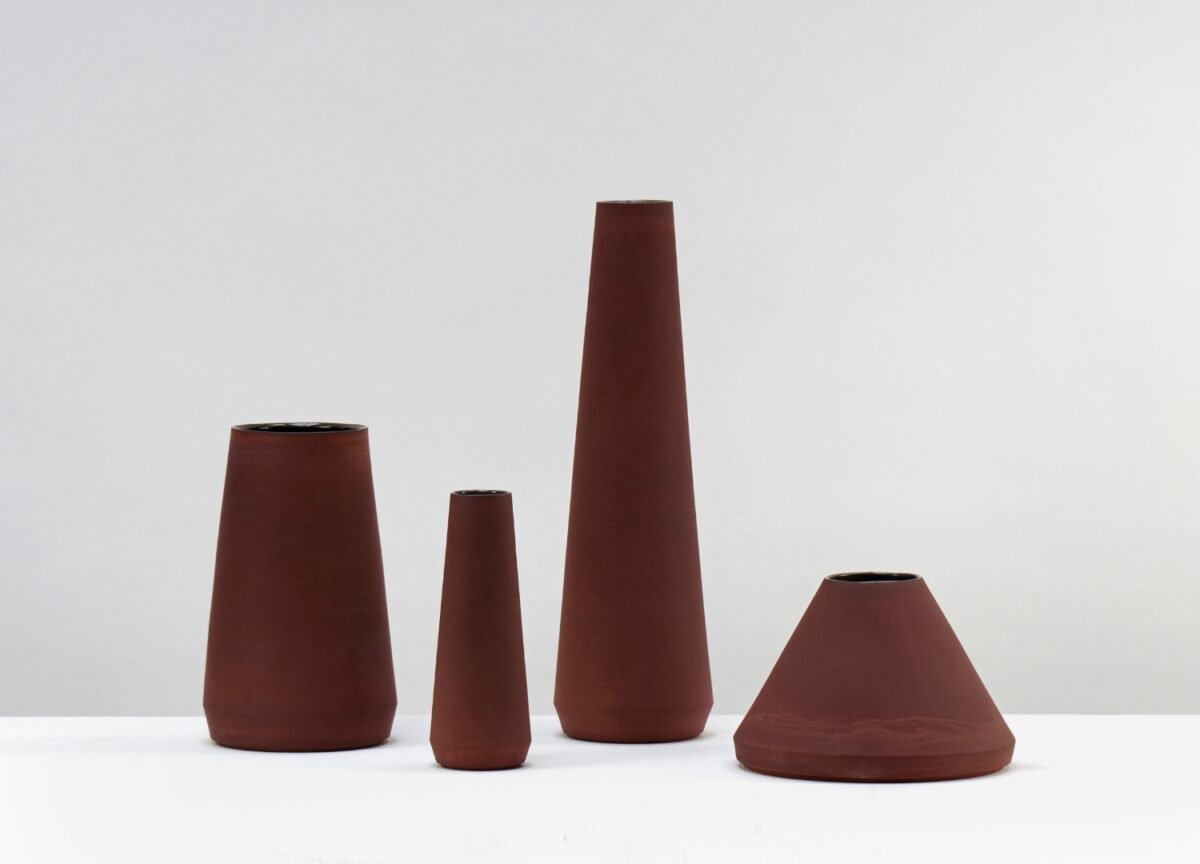
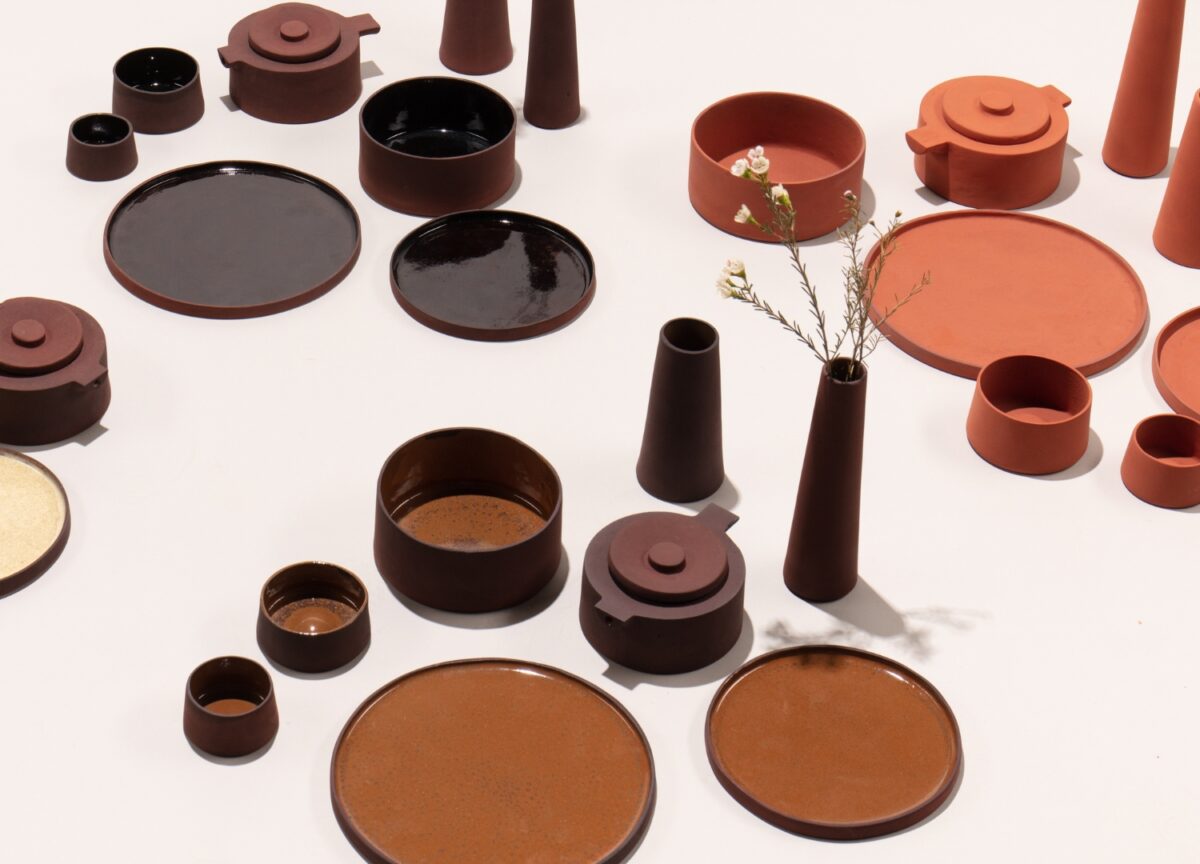
The nicest surprise was the glazes. Because red mud is so rich in metal oxides, it works as a glaze ingredient too, so we could make both the clay bodies and the glazes from the same waste. The range of finishes it gave us, from deep glossy blacks to warm ambers, browns and even blues, was far richer than we expected from a single material.”
Why did you choose ceramics as the medium through which to explore red mud? What does this particular material and craft tradition allow you to communicate that other applications might not?
Paco Böckelmann:
“Most of the research pointed towards bricks and tiles, and that makes sense: the volumes are so enormous that only the building materials industry can match their scale. But we kept asking why, after so many technically successful trials, so little of it had reached the real world, and what we as designers could add to that scientific effort.
We realised our role was less about the technical solution and more about communication. We could tell a more complete story of aluminium and how it is made, and offer a new perspective on bauxite residue itself. We know we won’t save the world with cups and bowls. But tableware is a very intimate category of objects, and that makes it a powerful provocation: would you eat and drink from something widely considered a “hazardous waste”?
At the same time, the fragility, finesse and warmth of ceramics stand in direct contrast to the scale and brute force of the industry that produces the residue. That contrast lets us draw attention to the industrial model behind our everyday materials. It also lets us show the material’s beauty and practical possibilities, a more hopeful picture of what this waste could become.
Ironically, we have now come full circle. We started with tableware rather than the bricks and tiles the research pointed to, and today we are working on scaling red mud into architectural materials such as tiles. We’re actively looking for architects, interior designers and developers who want to bring it into real buildings and spaces.”
More broadly, what do you hope this project will change about the way designers, manufacturers and consumers think about waste, resources and the value of materials?
Paco Böckelmann:
“We hope to show that every material has a counterpart that usually stays hidden behind factory walls. Behind the clean, gleaming aluminium of a laptop or a car, there is a red landscape you can see from space. We think it is important for everyone, from designers and manufacturers to the wider public, to better understand the industrial models behind how we produce and consume today. Our hope is that this understanding eventually leads to more thoughtful use of materials, and a greater appreciation for the ones we so often take for granted.
For designers in particular, we’d like Red Mud to be an invitation to step out of the studio and into factories, labs and waste sites, working alongside scientists and industry. Waste is rarely a dead end. More often, it is an abundant resource waiting for a new story.”

Anna Lazzaron
Anna Lazzaron is a designer, writer, and researcher based in Milan and Barcelona, working across material exploration and speculative practices.