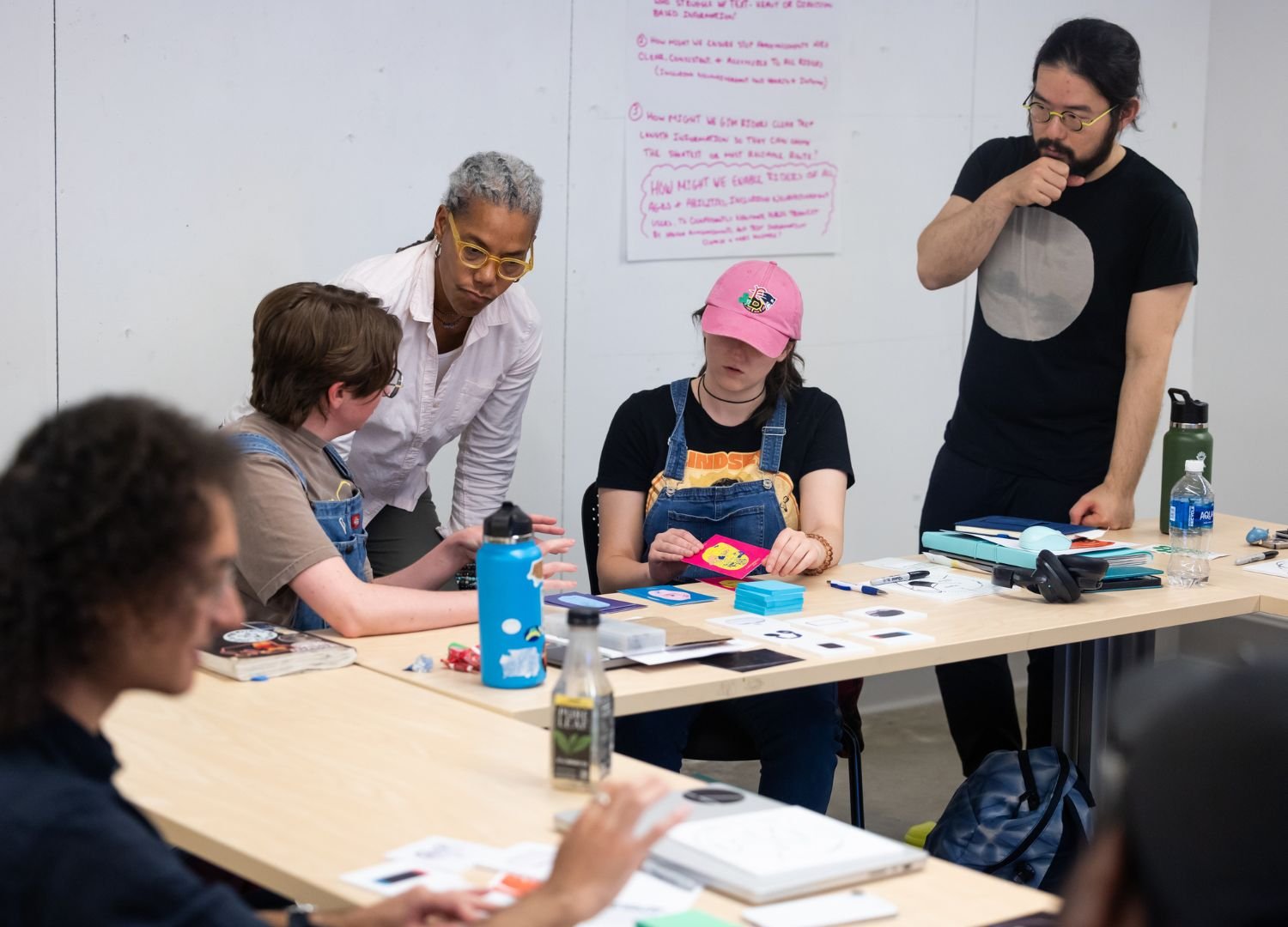
Ann Arbor may be freezing this winter, yet the passion for design and design education has made the semester feel warm. This semester, I have the privilege of teaching UT210 Listening: Design Ethnography Methods with 18 undergraduate students (I prefer to use the term emerging designers) in the Urban Technology program at the University of Michigan.
I am genuinely energized by both the course and the students. We are also fortunate to collaborate with General Motors (GM), enabling young talents to engage with real-world challenges while receiving professional feedback. Although the class is still amid its mid-term review process, I feel compelled to reflect on several early learnings and emerging insights.
Teaching today extends far beyond the classroom. If the learning objective were merely the acquisition of technical skills, students could easily turn to tools and technologies such as ChatGPT or YouTube. This reality prompts deeper questions:
Why do we gather in a classroom?
What are the design skills we want to develop?
How do we develop human skills?
Gallery
Open full width

Open full width
Perhaps what we are truly cultivating are design leadership, creative confidence, relational intelligence, teamwork, communication, and what Simon Sinek (2017) describes as human skills. Sinek characterizes these skills as the capacities that enable meaningful connection and empathy, including active listening and discussion, navigating difficult conversations, empathy and trust building, feedback literacy, patience, cross- and multi-disciplinary collaboration, self-awareness, self-regulation, and more.
Such skills become even more critical in the era of artificial intelligence (AI) and increasingly complex systemic design challenges. As we continue to ask which abilities can be automated, we also need to consider which remain fundamentally human.
I do think that design ethnography still stands firmly within this human domain—particularly in how we engage with people, conduct qualitative inquiry, capture and interpret lived experiences, and frame or reframe complex design challenges.
From this perspective, design ethnography is not simply a methodological toolkit or academic research approach; it is deeply tied to human development (Figure 1).
Design ethnography methods – Three key reflections:
Design ethnography is contextual learning
Design ethnography is not merely a research method. Rather, it functions as a contextual learning experience. Students do not simply learn techniques; they immerse themselves in real-world situations, interact with participants, and navigate ambiguity instead of applying predefined procedures.
This mode of learning resonates with John Dewey’s (1938) concept of experiential education, which emphasizes learning through engagement with lived situations rather than passive knowledge transfer. Similarly, Donald Schön’s (1984) notion of the reflective practitioner highlights how professional competence develops through action, reflection, and reframing within uncertain social-technological contexts.
In design ethnography, the central question is not only what we design or how we find solutions, but how we learn to see, listen, and feel.
I recall my early professional experiences. My first banking experience design project at Continuum, an international design consultancy, was deeply challenging; I had no prior knowledge of banking systems or interior space. Likewise, my first diaper-related project at IDEO placed me in a completely unfamiliar domain.
These projects were not simply about solving design problems or working hard to understand all this different domain knowledge. In hindsight, they were about developing the capacity to learn, adapt, and collectively make sense of the unknown.
This distinction reflects an essential principle in design thinking: rather than “giving solutions,” design education cultivates the capacity to frame and reframe problems, navigate uncertainty, and generate new meaning.
Design ethnography embodies this orientation toward learning. It requires students (or emerging designers) to attend to what remains unsaid, interpret tacit and implicit knowledge, recognize subtle patterns of behavior, synthesize ambiguity into actionable insights, and translate lived experience into design or business opportunities.
Such processes align closely with the foundations of design ethnographic inquiry, where meaning emerges through situated interpretation rather than detached observation or literal translation.
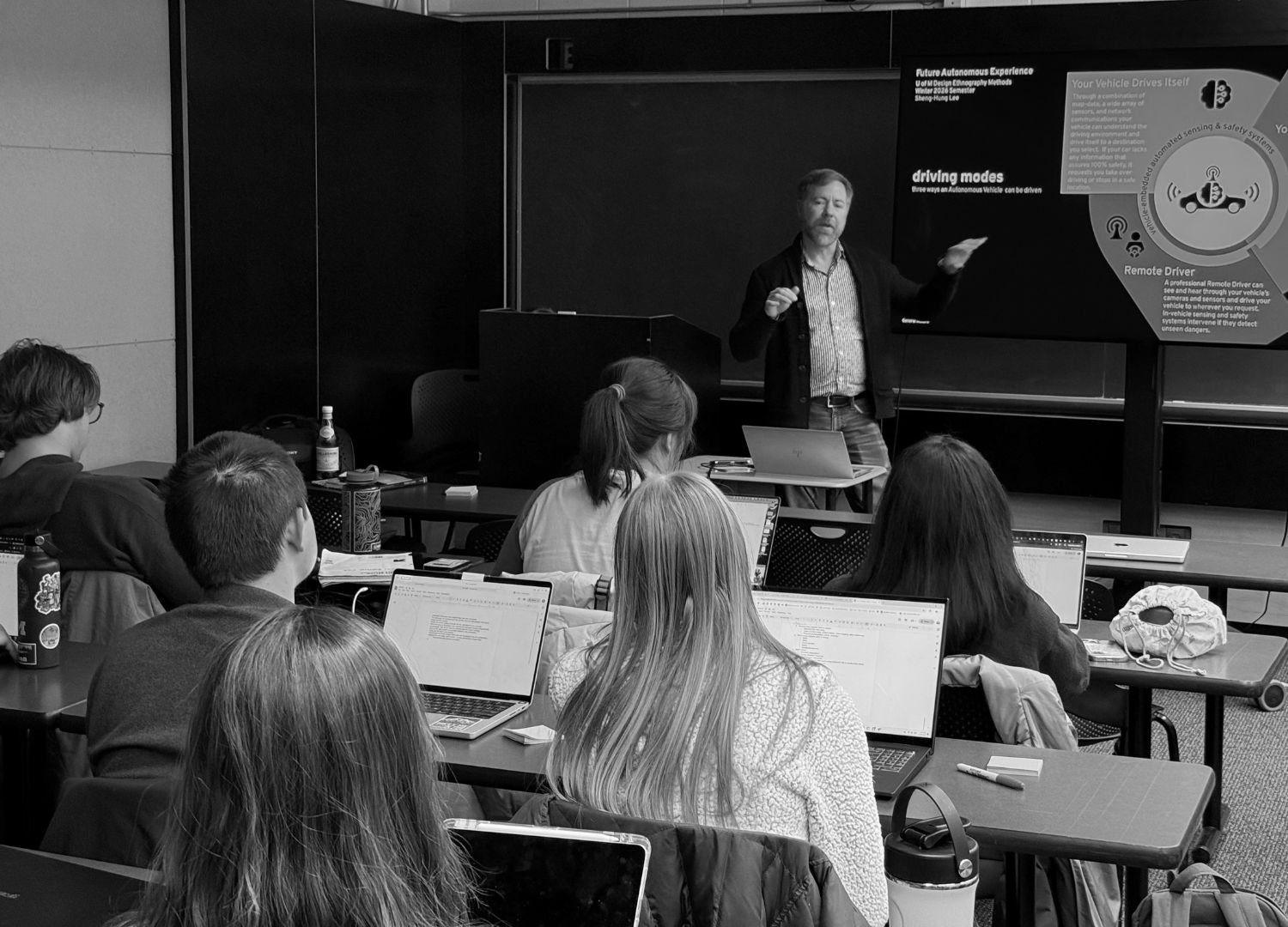
In UT210, students collaborated with GM to explore and envision future autonomous vehicle (AV) experiences (Figure 2). They practiced and applied semi-structured interviews, field observations, and photo diaries to understand participants’ perceptions, concerns, and aspirations about AV. Importantly, these design ethnography methods were not treated only as rigid procedures but as relational encounters.
Here, it is tempting to frame design skills and human skills as simply “learnable.” Yet many of these capabilities are more accurately understood as being developed through experience. Learning, in its conventional sense, often implies passive reception, whereas experience entails active participation, reflection, and transformation. From this perspective, learning should be inherently experiential, embodied, and dialogical.
This view resonates with Etienne Wenger’s (1998) Community of Practice (CoP) framework, which reconceptualizes learning as participation within evolving social and professional systems rather than as linear knowledge acquisition. Learning is not a journey with a clear beginning and end; it is an ongoing process of engagement, negotiation, and identity formation.
Notably, there are meaningful parallels between iterative design processes, such as the UK Design Council’s Double Diamond framework, and the CoP perspective. Both recognize that progress is rarely linear and that moments of uncertainty, ambiguity, and even disorientation are not signs of failure, but essential conditions for development and growth.
Students are emerging designers
Within a CoP, students are no longer positioned as passive learners. Instead, they participate as emerging professionals—or, as I prefer to describe them, creative young designers. This new language framing and shift is not merely rhetorical. I think the use of language has power that can shape identity, and identity, in turn, shapes the types and level of participation (Wenger, 1998).
To describe learners as designers is to foreground agency, contribution, and potential rather than dependence. This perspective might reframe our design education as a space for growth rather than mere transmission. In turn, my role naturally evolves—from instructor to facilitator, project coach, and even co-participant in the process of inquiry.
Course participants or creative young designers are not simply acquiring design or research techniques. They are developing human skills essential for engaging with real people and real problems, including empathy, ethical sensitivity, confidence, relational intelligence, and reflexivity. These capacities cannot be reduced to procedural knowledge; they emerge through situated interaction, negotiation, and lived experience.
I think design ethnography is particularly powerful in cultivating these human skills because it places students (or designers) in conditions where knowledge is incomplete, perspectives are multiple, and human complexity resists simplification.
Such environments demand humility, curiosity, and interpretive sensitivity, qualities central to both design practice and ethnographic inquiry. This resonates with Jeanne Liedtka’s (2018) characterization of design thinking as a social technology, one that integrates practical tools with human-centered insight. Design ethnography methods, in this sense, are not merely analytical instruments; they are relational practices.
In UT210, fostering a flatter and more open classroom culture has therefore been critical. Creative problem-solving rarely flourishes under rigid hierarchy. Instead, psychological safety—the shared belief that space where one can speak, question, and experiment without fear—becomes foundational.
Without safe environments, authentic listening and genuine empathy are difficult to sustain.
Human skills, consequently, are not taught through instruction alone. They emerge through relational dynamics, collaborative inquiry, and the willingness to engage uncertainty together.
Design is an applied science
Design is often positioned as a creative discipline, associated with imagination, aesthetics, and innovation. Herbert Simon (1969) offered a profoundly influential reframing, describing design as a science of the artificial: a field fundamentally concerned with transforming existing situations into preferred ones. In this view, design is not defined by the artifacts it produces, but by its orientation toward intentional change.
Richard Buchanan (1992) further extended this understanding by linking design thinking to the notion of wicked problems: challenges characterized by ambiguity, uncertainty, and incomplete definition. Wicked problems resist straightforward solutions; they are ill-structured, context-dependent, and continually evolving. Designers, therefore, do not merely solve problems. They engage with situations in which the problem itself has been interpreted, framed, reframed, and often evolved.
This interplay between uncertainty, complexity, and intervention underscores the relevance of design as an applied science.
Unlike traditional scientific disciplines that seek universal laws, design operates within the contingent realities of human life. It navigates tensions between analysis and synthesis, logic and intuition, structure and emergence. The diversity and complexity of design practice thus enrich and expand the notion of design as a field grounded not only in creativity, but also in systematic inquiry, reflective judgment, and contextual reasoning.
From this perspective, design ethnography functions as a critical bridge, connecting human experience, systemic understanding, and processes of intervention and transformation. It integrates rigor with empathy, analysis with interpretation, and methodological structure with lived experience and ambiguity.
Design, then, is neither purely artistic nor purely technical. It is an applied, integrative practice grounded in human realities, a discipline concerned not only with what we create, but with how we understand, interpret, and reshape the conditions of everyday life.
From Human Being to Human Becoming
In an era increasingly shaped by AI and automation, the enduring value of design education may reside not only in technical mastery, but in the cultivation of what remains irreducibly human.
Human being suggests a condition, a momentary state, a description of who we are. Yet design, by its very nature, concerns itself not with stasis, but with movement. I find myself drawn instead to human becoming: who we may grow into, what we may learn to see, and how we might prepare our future selves with deeper empathy, broader inclusiveness, and greater sensitivity to possibility.
Becoming is not a destination. It is a continuous potential unfolding.
Design ethnography, in this light, is more than a methodological approach or mindset. It is an invitation: a way of entering the worlds of others with attentiveness, humility, and care. It reminds us that design is about:
- Understanding, appreciating, and even honoring lived experience
- Engaging with and embracing the richness and contradictions of human complexity
- Learning not only by memorizing, but by participating and experiencing
- Supporting and envisioning the open-ended process of human becoming
This orientation echoes some perspectives in learning theory. In John Dewey’s (1938) Experience and Education, he reminds us that education is grounded in experience. In The Reflective Practitioner: How Professionals Think in Action, Donald Schön (1984) frames professional growth as reflection-in-action within uncertain situations.
Similarly, Etienne Wenger (1998), in Communities of Practice: Learning, Meaning, and Identity, positions learning as participation in evolving communities of practice, where identity itself is continually formed and reformed.
From this view, design education is not simply about producing competent design practitioners. It is about nurturing reflective, empathetic, and adaptive individuals—individuals capable not only of solving problems, but of perceiving, interpreting, and shaping more meaningful, humane, and imaginative futures.
Because design is not only about designing the world.
It is also about designing who we are becoming within it.
Reference:
About the author

Sheng-Hung Lee is an Assistant Professor of Urban Technology at the University of Michigan and Director of the d-mix lab. Trained in both design and engineering, his work explores how technology and human-centered design can shape more equitable and longevity-ready societies.
WebsiteInstagramLinkedin