Fell down the rabbit hole with Sechser, the new Heterotopic Nightclub in Vienna
From the scratches of the undergrounds of Palais Palffy, Söhne & Partner architects have created a surreal nightclub inspired by Late Renaissance.
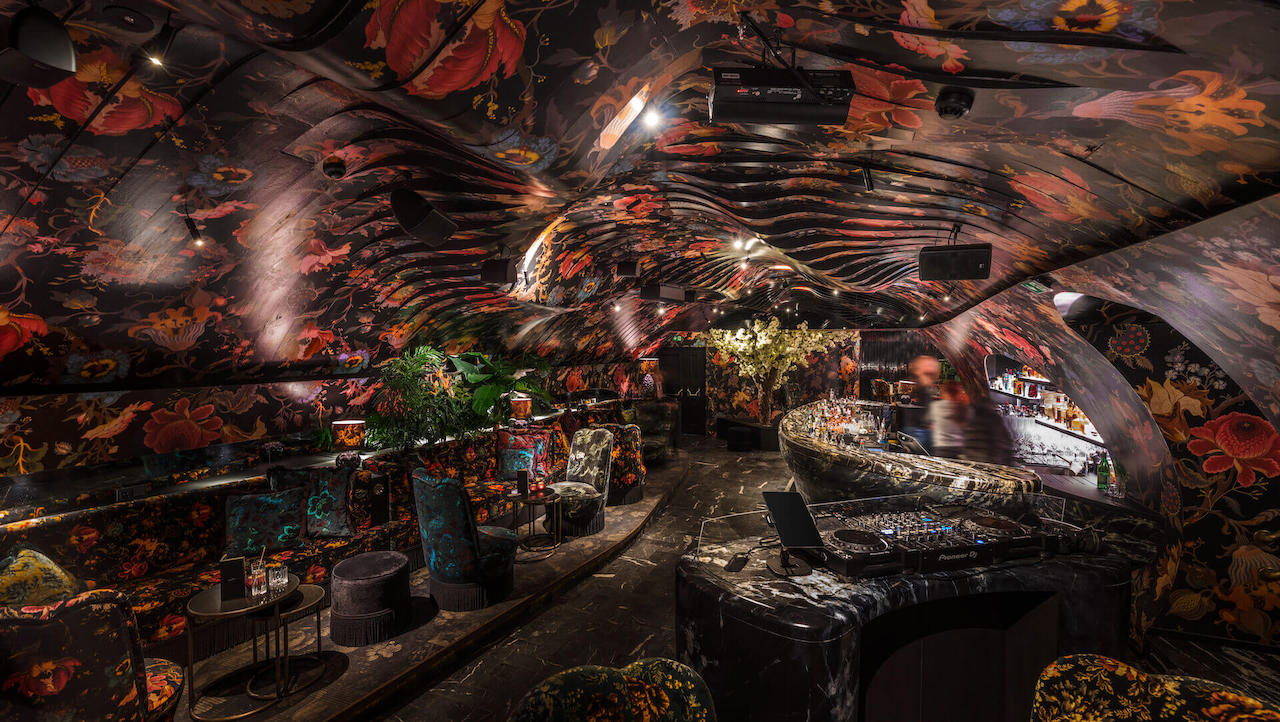
The design concept of the new Sechser bar and nightclub is Mannerist. Mannerism, also known as Late Renaissance, has always stood for a time of change in the historical context and is characterized by adornment, uncommonness, opulence, artificiality, and abstruseness.
To keep up with the current trend of Mannerism, the location was developed with clashing styles as well as opulence, by using fine fabrics and wallpapers from House of Hackney London.
Gallery
Open full width


Open full width
The most challenging aspect was to transform the basement rooms into an extravagant world. In order for the guests to have a dream-like experience, we replaced the characteristic barrel vault with a dynamic and undulating ceiling construction, transforming the rooms into an unusual, crazy and surreal world – making the ceiling alive.
The non-predictable aspect is manifested by the ceiling that enhances the complexity of the whole clubbing environment. The heterotopia is accentuated by the curved shapes, that evoke confusion and drama. With violent colors, patterns, shapes, and reflections, Sechser creates a decadent and provocative world never seen before. This world is born from the interplay of form, function, and materiality.

Heterotopia (from gr. hetero= different and topos= place) is a term defined by Michel Foucault in the early years (1967) of his philosophy, to describe places and their intrinsic systematic meaning made of more layers to other than immediately meet the eye. Foucault assumes that there are spaces that are reflecting the social relations in a special way, by representing, negating and inverting them.
Thanks to its dimension and “function” as a bar and club, Sechser is ultimately more than just space. Instead, it harbors a colorful facet of spatial phenomena. Sechser invites the guest to perceive the space in many different ways: physical space as an object, aesthetic and personal space as a piece of art, physiological space as a body experience, psychological space as an experience space, and metaphysical space as heterotopia.

Beyond its visual impact, Sechser demonstrates how nightlife venues can become platforms for spatial experimentation. By embracing contrasts—between light and shadow, softness and structure, order and disorientation—the project challenges traditional expectations of club design. The architects use these tensions deliberately, allowing visitors to experience the space as an unfolding sequence rather than a static environment. This approach reflects a broader shift in hospitality architecture, where immersive atmospheres are increasingly used to shape social interaction and emotional engagement.
Seen through this lens, Sechser is not simply a nightclub but a spatial narrative about perception and transformation. Located in the underground floors of the former Palais Palffy, the project transforms a historic basement into a surreal environment where architecture amplifies the intensity of nightlife culture. The design plays with theatrical elements—bold textures, dramatic forms, and layered spatial cues—to create a setting where architecture becomes an active participant in the experience of music, movement, and collective energy.