Re-envisioning Amsterdam as an eco-city of the future
In the designed scenario, the Waterland district which connects to Amsterdam Noord would become an agricultural production, storage and distribution hub. Bringing the city to self-sufficiency.
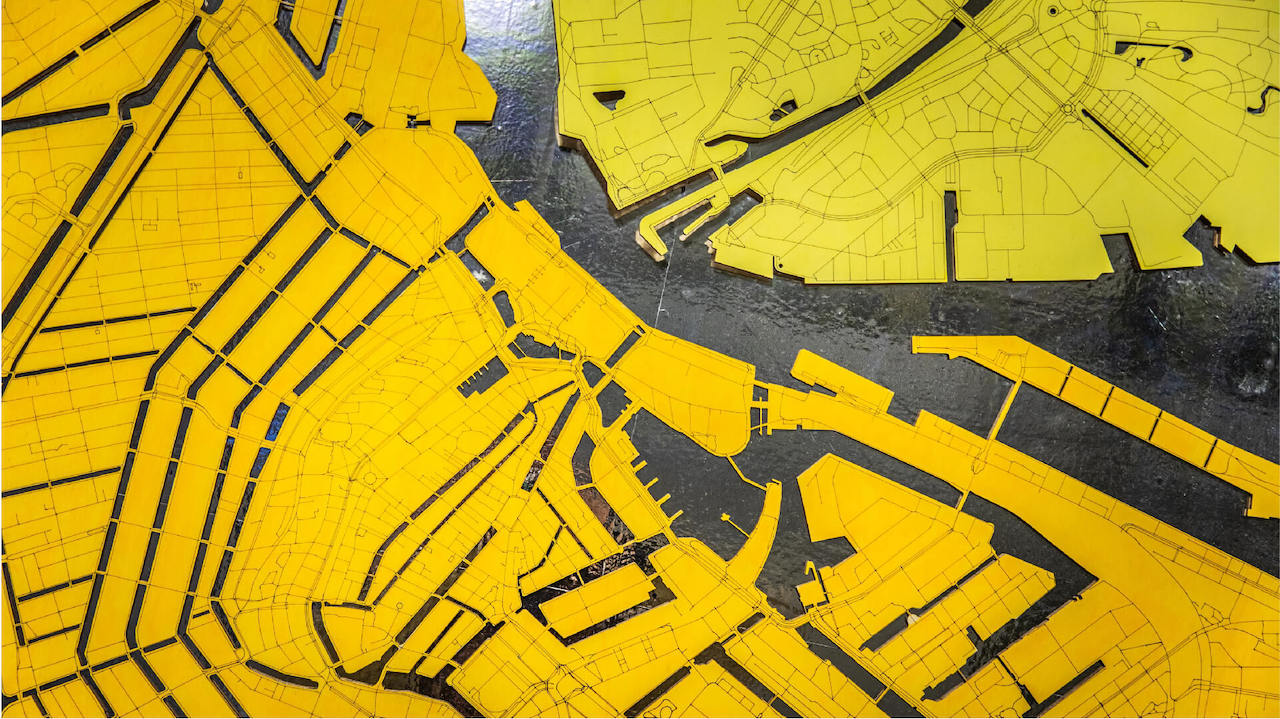
How could we supply food to an urban population without relying on a global food chain and industrial monoculture? Different agricultural techniques and technologies are combined in the Uprooting Agro-Systems – from the growing of the crops to the storing and distributing of them, meaning the city would be provided for all year round.
This is not a ‘one-solution-solves-all’ but rather an optimal combination of various systems: Syntropic Farming, Food Foresting and Vertical Farming.
Gallery
Open full width


Open full width
Each has its own benefits that outweigh downsides. Where one approach comes with a disadvantage, another one has a backup. For example, Syntropic Farming offers production efficiency and biodiversity and Food Forestry is able to grow large varieties on limited space, needing little to no maintenance. But neither are reliable in the winter months. This is why Vertical Farming is integrated – with an artificial climate, it produces “all year round” and on a consistent output.
The richness and biodiversity of the Food Forest would also work to purify the urban air – acting as the ‘lungs’ of Amsterdam, UprootingAgro-Systems also employs new technologies to tackle the challenge of harvesting crops. In the proposed ‘Food Forest’, standard harvest machinery could not be used, which is why drones are employed – they can be programmed to harvest crops at the optimum time. ‘Buy-local’ has been a rallying cry for a few years now, but how could we supply everything for an urban population year-round? Using a mix of methods is crucial.

People have often tried to find the ultimate utopian system, but when we look at history, these systems have revealed their negative sides over time, such as the so-called “Green Revolution” that started in the 1950s when industrial agriculture really took off. Today, these agricultural methods have reached their ecological limits. With this proposal, I am convinced that it is possible to make a whole city self-sufficient. The ambitious plan would transform a whole district of Amsterdam, the Waterland, into an ecological power house where most of the needed food is produced.

Those who have been to Amsterdam know about the dense network of canals that span the city. It’s the ultimate distribution system when combined with the excellent cycling infrastructure. It would also make it very transparent and easy to understand where your ingredients come from – you might even run into the farmer that produced last night’s aubergine.
Having recently founded my own design practice in Eindhoven, I hope this project will inspire ideas and exchange with like-minded people from other disciplines as well. It’s a proposal, based on a combination of many possible solutions I came across during my research. I do not claim to have the final answer in this, but rather hope to bring many interested people together.

Projects like Uprooting Agro-Systems also highlight a broader shift in how designers and urban planners approach food infrastructure. Instead of relying exclusively on large-scale industrial agriculture and global supply chains, many contemporary proposals investigate localized production models that integrate food cultivation directly into the urban fabric. By combining complementary systems—such as syntropic farming, food forests, and vertical farming—Bram de Vos proposes a hybrid approach where the strengths of each method compensate for the limitations of the others, ensuring productivity, biodiversity, and year-round output.
Beyond food production itself, the concept suggests a wider ecological role for urban agriculture. In the case of the proposed food forest for Amsterdam, biodiversity would not only support crop growth but also improve environmental quality, potentially acting as a green lung for the city while fostering new relationships between citizens and their food systems. Technologies such as drone harvesting further illustrate how design, ecology, and emerging technologies can converge to rethink the future of sustainable cities.